
Here is the link to my Rosh Hashanah sermon on unlearning.
You can watch the video here.
Memory is a funny thing.
It was just days ago, with thanks to some keen savers, I put your grandchild in a sweater you made.
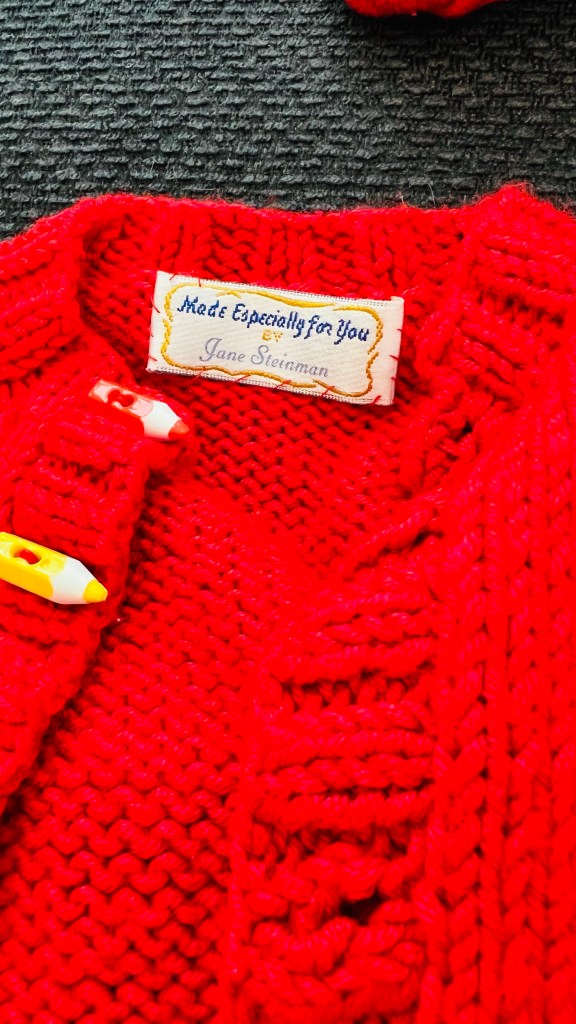
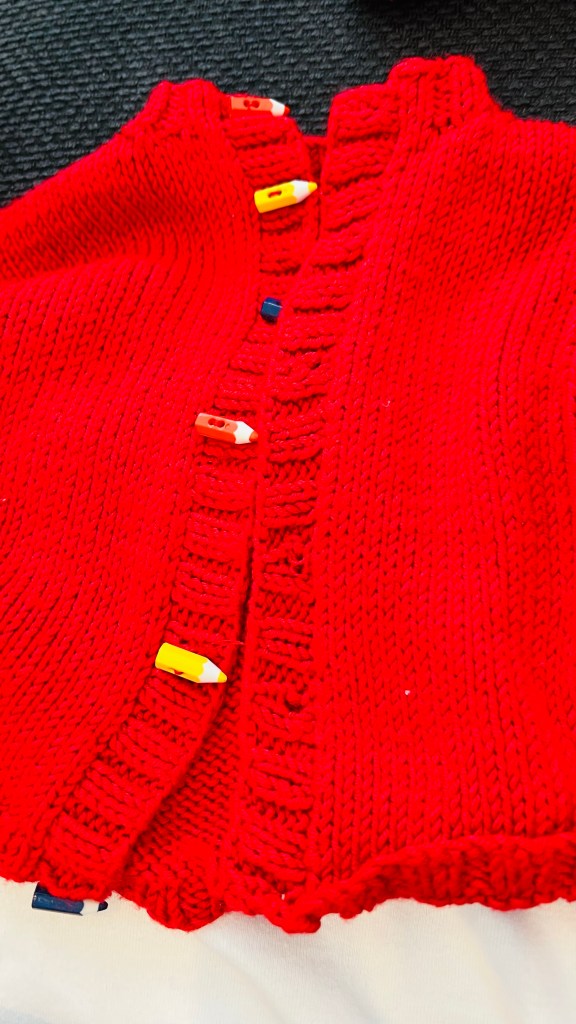
As with every garment of clothing this child wears, it was perfect. The yarn was soft from careful washing and gentle wear, the buttons just as you attached them, and your namesake’s big blue eyes shone. Your memory is alive in the stories we tell RJS, the pictures she sees, and in the music we sing. You would have laugh-cried when you saw her face as MY SISTER and I reenacted a childhood VHS tape from a music class, “the little red caboose.” RJS’s giggles of delight when we added her to the caboose were angelic.
And now, it is just days later, I pull out the candle, and I FaceTime my wife, and the tears flow for somehow 12 years went by in the blink of an eye. I miss you every day, Mom, and I love you forever.


Here is my Kol Nidre sermon.
Here is the text of my Erev Rosh Hashanah drash, Generous Hearts. Video to hopefully be included later.

This was my Shabbat sermon for Parashat Va-etchanan, Shabbat Nachamu, delivered at Temple Beth Shalom, Austin, TX.
On my summer vacation, I slept with shoes by the bed. As a former Californian, the land of earthquakes, this is nothing new to me. And still this was entirely different. As those of you who use social media and follow me know, I’ve just returned from a trip to Israel. My wife, Rabbi Denise Eger was co-leading a group of LGBTQ Christian clergy with an organization called A Wider Bridge. This group connects the LGBTQ community in the United States with the LGBTQ communities in Israel. Our trip started in Jerusalem and last Shabbat we were in Tel Aviv and then in the Galilee region in the north.
I am very blessed to tell you that I’ve traveled to Israel so many times I lost count as to what number trip this was. From the time I was 17 years old when I participated in Alexander Muss to today, whenever I am able to, I go to Israel. For my first year of rabbinical studies at the Hebrew Union College, staffing a birthright trip, leading congregational trips, I do not need an excuse. I love Israel.
I love the rolling hills, the coastlines of the Mediterranean, the Dead Sea and the Kinneret the Sea of Galilee that are so beautiful. I love the barrenness of the Negev desert juxtaposed by the ingenuity of the scientists and hard working people who made the desert bloom to produce life. I love the creativity of the scientists and the technology that now produces most of Israel’s drinking water through desalinization instead of from freshwater sources like the Jordan River. Fruits and vegetables taste better, the dairy products are phenomenal in Israel. The chocolate is pretty good too. I love shopping at Machane Yehuda or any of the open-air markets, is fun and delicious. It is so powerful to read a passage about King Saul on Mt. Gilboa and then going for a hike on the mountain or reading about Elijah the prophet in Carmel and seeing the ridge near the city of Haifa.
And don’t even get me started on Hebrew. I love the Hebrew language, speaking it sometimes poorly, understanding how new words are constructed, even. One of the main shopping streets in Tel Aviv is Dizengoff after the first mayor. When one shops on that specific street the Hebrew word is l’hezdangef – to shop on Dizengoff! Genius. There is so much that I love about Israel. I cannot wait to travel with you as we take a congregational mission to Israel next May, May 30 to June 7, 2023. I cannot wait to share with you this place that I love and to be with you as you discover for yourselves your own love list about Israel.
And like I love my sibling, there are things that make my relationship with Israel complex. As safe and ‘at home’ as I feel in Israel, I know that is not the experience of every person all the time. There is tremendous poverty, our Reform and Conservative congregations struggle against the chokehold of the Orthodox establishment that seeks to minimize our presence, our voice, and our rights. Israeli Arab citizens do not have all of the rights that they ought to and then there’s the situation. The “matzav”, the situation, the Occupation is ever present. Israel is not a perfect place. I do purport to you that everything is visible through rose-colored glasses. I am not naive and you ought not be either.
On my summer vacation, I slept with shoes by the bed.
Why, you ask? Because I was abroad I do not know what was reported on the news here so let me fill you in briefly. Last Monday, Israel arrested the leader of Palestinian Islamic Jihad, a terrorist organization in the West Bank. Tragically in the raid, a 17 year old was killed in exchange of fire. Tuesday, fearing retaliation for the arrest, Israel closed the roads in the south near Gaza. Israeli residents were told to stay home near their bomb shelters. They were only permitted to go to work if their office had a shelter. Tensions were very high all week and last Friday, Israel launched operation Breaking Dawn going after specific targets in Gaza. Friday afternoon Palestinian Islamic Jihad began launching rockets into Israel. Iron Dome, Israel’s missile defense system goes to work shooting down rockets that threaten any population in Israel. Last Friday as I prepared for Shabbat I could hear the booms of Iron Dome launching and the subsequent sound of it stopping a rocket.
Our group’s itinerary changed. We did not go to Sderot on the border with Gaza. We could not travel to Ramallah to meet with Palestinians. We made alternative plans and I always knew where I would go if I heard the siren to get to a shelter. I sent a text message to my dad and my sister to let them know that I was fine and what was going on in Israel and half-joked that international text messaging wasn’t available during my year in Israel during the second intifada. And I slept with shoes by the bed in case we needed to move to the hotel’s bomb shelter in the middle of the night.
In three days more than 1100 rockets were fired at Israel from Gaza. Sadly more than 200 fell in Gaza harming innocent Palestinians. More than 990 of them crossed into Israel and Iron Dome intercepted more than 380 of them, a 96% accuracy rate. And then there was a ceasefire.
Last Sunday was Tisha b’Av. The day we commemorate the destruction of the first and second Temple in Jerusalem. It is a day for mourning, weeping. It is also a reminder of baseless hatred. Our tradition teaches that it was this baseless hatred – sinat chinam – that led to the Temple’s destruction. And this year on Tisha b’Av a ceasefire was brokered.
This Shabbat for Jews throughout the world is known as Shabbat Nachamu. After Tisha b’Av, the sadness, the emotion, and the mourning we turn again to the Prophet Isaiah to learn. This special haftara begins “נַחֲמ֥וּ נַחֲמ֖וּ עַמִּ֑י יֹאמַ֖ר אֱלֹֽהֵיכֶֽם׃” – “Comfort, O Comfort My people says your God. Speak to the heart of Jerusalem and call out to her, for her term of service is ended, her crime is expiated.” It is not clear to any of the scholars who the prophet is speaking to, who precisely it was at the time that Isaiah sought to bring consolation. What is known is that it was needed then. And I can tell you assuredly that it is needed now, too. The Israeli and Palestinian peoples need comfort. We need assuredness that even in the midst of the complexities of our day, the complexities in our beloved Israel, the difficulties and the strife in our country, in our communities, and families, and in ourselves we can know solace.
On this Shabbat Nachamu may we be peace builders. May we find peace in our hearts and hold it within and share it with others. May each of us have the opportunity to travel to Israel, to meet peacemakers and to be peacemakers. And may we only sleep with shoes by the bed if it is going to give us a peaceful night’s rest. Amen.
Something felt heavy on my heart all day. It took me awhile to realize why. Tonight begins the final day of Passover and tomorrow is the Yizkor service, so tonight in addition to the holiday candles, I will light a yartzeit candle to remember MY MOM. 11 years ago, after she died in the winter of 2010, Passover was the first holiday I recited the Yizkor prayers as a mourner and lit a candle at home. (If you’re really curious you can dig through the previous posts and find my thoughts then).
And the reason it feels so different is a tremendously joyous one. Mom you have a grandchild now, RJS. This beautiful soul who shares your name was born just days after the anniversary of your death. You, like all of us, would be overwhelmed by love for this precious one. RJS’s presence has made MY SISTER and me miss you more than ever.
So tonight I will light the candles and remember you. I promise RJS will hear endless tales of you from the sublime to the ridiculous. We will sing all of your favorite songs, make your best recipes, will go to the theater and the symphony, and will sing along to songs in the car (we are already have evidence of RJS’s vocal prowess).
I love you, Mom. I miss you.

Today was one of “those days.” I got to be a rabbi today. That was wonderful. I prepared some words of Torah, I met with congregants, I worked on the forth coming CCAR convention, and I evaluated some student work from my students at HUC-JIR. I ate healthy meals, I made time to exercise. It was good.
Today I also had to write a letter for a congregational family to put in their “safe file”. There have been many challenging days in my rabbinate and this will count among them. The fact that my people need a “safe file” because they provide their children with gender affirming care is so upsetting. A “safe file” is a collection of documents that families that include transgender, non-binary, and gender expansive kids are recommended to have on hand as the Texas attorney general and governor attack these families. (Equality Texas, ACLU, and Lambda Legal have excellent resources available. Let me know if you need them).
I am vacillating between rage and utter shock that this is the reality for people in Texas. And so this day will end with donations to the organizations linked above and my unwavering commitment to these families.
Families that include transgender, non-binary, and gender expansive people you are loved. Tonight I will try to sleep so tomorrow I can continue the work.
Baruch Atah Adonai Eloheinu Melech ha’Olam matir asurim – Blessed are You, Adonai our God infinite Sovereign who frees captives.
Every morning we recite this blessing and since Saturday night when our siblings in Colleyville fought for their escape from terror, this ancient blessing’s meaning for us, the 21st century Jewish community, holds new relevance. We are so grateful to God that Rabbi Charlie Cytron-Walker and three Congregation Beth Israel congregants could recite this blessing on Sunday morning and every day since then.
We are so grateful that we are able to come together as one Temple Beth Shalom community here in our Sanctuary in person and online to celebrate Shabbat, to proudly proclaim the words of our tradition old and new, to pray for healing for those we love, and, perhaps, to allow ourselves to connect with the panoply of emotions we have known this week, to name them aloud or privately, to begin our own healing from the trauma of yet another antisemetic terror attack.
Since last Shabbat, we have been reminded of the resilience of the Jewish people. That no matter how tired, fear-filled, or angry we may be, we will bounce back. That no antisemetic act, that no antisemetic trope will hold us back, will silence us, will close our doors, will keep us down. As Dr. Deborah Lipstadt wrote this week:
We are resilient because we cannot afford not to be. That resiliency is part of the Jewish DNA. Without it, we would have disappeared centuries ago. We refuse to go away. But we are exhausted.
Lipstadt, D. “For Jews, going to services in an act of courage.” New York Times. January 18, 2022. https://www.nytimes.com/2022/01/18/opinion/texas-colleyville-antisemitism.html?searchResultPosition=2
Resilience is a powerful and palpable part of our lives as Jews. And where does it come from? As Dr. Lipstadt says, it comes from our DNA, and it comes from the sacred narrative that binds us together that we read in Torah.
This week we, a newly liberated people, stand at the foot of Sinai and bear witness as our great leader, Moses, communes with God and receives the 10 Commandments on our behalf. From the moment at Sinai and every second since, we are no longer only a people redeemed, we are a people in covenant, in sacred partnership with God. And because of that sacred relationship with our Higher Power, with the Force of the Universe, with Avinu Malkeinu our Parent and Sovereign, with El Chanun v’Rachum, God who is merciful and gracious, we know even on a cellular level who we have been, who we are, and who we will be and that is am Yisarel, the people of Israel. It is at Sinai that we take responsibility for sacred obligations that define the way we as a Jewish people live, engage, and change the world.
Rabbi David Hartman taught:
The model of Sinai awakens the Jewish people to the awesome responsibility of becoming a holy people. At Sinai, we discover the absolute demand of God; we discover who we are by what we do. Sinai calls us to action, to moral awakening, to living constantly with challenges of building a moral and just society which mirrors the kingdom of God in history. Sinai creates humility and openness to the demands of self-transcendence….
Hartman, D. “Auschwitz or Sinai?” Original publication 1982. https://www.hartman.org.il/auschwitz-or-sinai/
What do we do? We learn Torah, we light Shabbat candles, we celebrate lifecycles, we advocate for social justice, we welcome the stranger, we pray that stir our souls, we relentlessly pursue a democratic Israel, we teach our children, we support Jewish summer camps, we strive for a relationship with God to build a more just individual and a better world. We are resilient.
And our model for this resilience comes from another place in our Bible, from the Ketuvim, the Writings where we find the story of Iyov, of Job. The quick summary of this story is that Job is a blameless person with a partner and 10 children and considerable wealth. Job is a profoundly faith-filled person and in a complicated twist, everything is taken from him. He loses his wealth, and most horribly, his children all die as they are feasting and a terrible storm causes the house to collapse on top of them. Job’s life is completely up-ended and in 42 chapters of complex Hebrew and even more complex theology and narrative, he is visited by four friends who encourage him to curse God and his situation and Job refuses to do so. Even towards the end, when God comes to visit Job in a whirlwind, Job’s faith is steadfast. Even when considering the most profound losses imaginable, the most challenging theological ideas, Job is unwavering. Job is resilient. And finally, in the last chapter, Job finally speaks and he says:
I know all that You can do and no evil thought can be cut off from You. Who is this that hides counsel without knowledge, tell me! I did not understand the wonders before me, I did not know. Listen! I will speak; I will ask of You and You will tell me. I heard You with my ears and now my eyes have seen You;…
Job 42:2-5, translation my own
Job teaches us that even in the depths of difficulty, of antisemitism, of profound losses, we can turn to God and we can take comfort, and when our faith is challenged, we can find solace in the teachings of our tradition. That does not mean we deny our pain and trauma. Instead, when bad things happen, and sadly they will, as Jews connected to that Sinai experience, connected to God and one another through the covenant, we can fortify our hearts and spirits. We can mend our wounds, we can ask for help, and we can pick ourselves up, strengthen our alliances, and continue to do as we do.
The fourth of those 10 commandments reminds us to zachor et yom haShabbat l’kodsho, remember the Sabbath day and sanctify it (Ex. 20:8). This week and maybe every week, Shabbat can be a symbol of our resilience, too. As the world goes about around us, we pause and embrace the rhythm of Jewish time and Jewish tradition. Even after a week like the one we have had, we can fill our hearts and souls with space for prayer and for God just like our siblings doing just as we are in Colleyville. And then, perhaps, please God, we can create the world that fulfills the vision of the prophet Micah who taught, “and then each person shall sit under their vine and fig tree and none will be afraid,” (Micah 4:4
Ken y’hi ratzon, may this be God’s will.
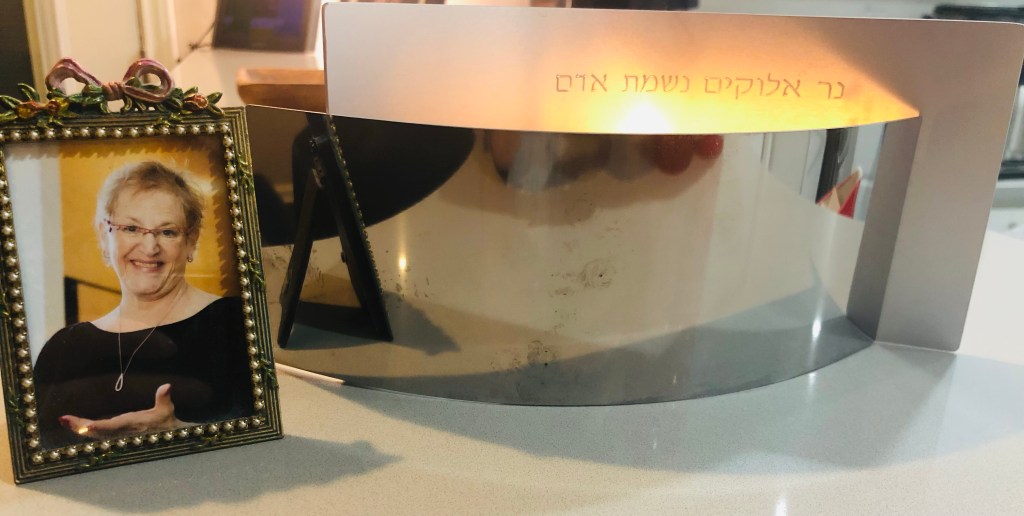
Tonight, again, I light the yartzeit candle. For 11 years, on the 5th of Kislev, I remember you. The cruel twist is that I don’t need to light a candle to remember you. You’re in every dish I cook, every day when I wear a piece of your jewelry, or every time I express my love to our family. I love you forever, MOM. I miss you.
We keep saying it over and over again. “I can’t wait for things to get back to normal.” We have such high hopes for normal. We will take that trip to Europe we planned, or have our grandchildren sleep over. We will have that big birthday party with all our or go back to pick our own produce at the grocery store. We will leave the job that we hate and jump into something new or we will go back to the office five days a week or not. We’ll go to a UT football game or not feel afraid every day our kids go off to school. There is so much we long for.
In a recent Washington Post article, Amanda Uhle wrote about what was happening around her home in Ann Arbor near the University of Michigan football stadium. In January the 100,000 seat stadium was a mass vaccination clinic and now, nine months later it was the site of an in-person football game, masks and vaccinations encouraged but not required. The forthcoming game could turn into a super spreader event, or it could not.[i] She wrote, “I knew that that crowded game might be bad for everyone who attended — and, most likely, for those of us who merely live in the region, too. And yet in the lead up to the gathering, I couldn’t help but thrill a little at the fact that it was happening at all. It’s a story about the world being normal again, and the glory of autumn afternoons in the stands.”[ii]
We all long for things to be as they were before March 2020, for what was normal. And now brace yourself because I have some news. The only place that to find normal is a setting on our washing machine or dishwasher. Normal just doesn’t exist. And still we long for it because we struggle with ambiguity, with the uncertainty that has marked the last 18 months of our lives. While this may sound trite, the reality is that there is no going back, there will be no return to normal.
We are living with ambiguous losses. Ambiguous loss is one that occurs without closure or clear understanding. It leaves us searching for answers, thereby complicating the grieving process. Dr. Pauline Boss coined this term in the 1970s.[iii] Her research centered around immigration, addiction, divorce, and aging parents. Ambiguous loss, she found, occured around more catastrophic events, such as war, genocide, slavery, holocaust, natural disasters, or catastrophic illnesses or head injuries.[iv] Ambiguous losses cause frozen grief.
The experience of ambiguous loss presents itself like this: first, because loss is confusing, people are baffled or immobilized and struggle to make sense of the situation. Second, uncertainty “prevents people from adjusting to the ambiguity of their loss.”[v] Third, “people are denied the symbolic rituals that ordinarily support a clear loss.”[vi] Fourth, “the absurdity of ambiguous loss reminds people that life is not always rational and just…”[vii] Finally, ambiguous loss is a loss that goes on and on, those who experience it become physically and emotionally exhausted from relentless uncertainty.
Sound familiar?
This is a description for so many of us now or at any point in the recent past. As a people we have gone through this before. In the book of Numbers, our Israelite ancestors get fed up with the uncertainty of the future in the unknown of the wilderness the promise of the Land of Israel. We read in parashat Beha’alotecha that the Israelites became complainers, they yearn for the life they knew before. The abundance of food in Egypt. That’s right, Egypt, the place where they were enslaved is what they desire. The familiar, the known, slavery, seemed better than the uncertainty of what lay before them on the journey to the Land of Israel. The dramatic shift from slavery to freedom, including the trials and tribulations of the wilderness, was not without difficulties. Part of our collective memory as a Jewish people also holds in it ambiguous loss, too.
One of the ways to manage ambiguous loss is with ritual. Rituals provide closure, they give hope, and they enable us to move forward. Yom Kippur comes at just the right time. Yom Kippur, its rituals and liturgy, provide us with the opportunity to confront what was and prepare for what will be. This Day of Atonement cannot cure our ambiguous loss, that isn’t possible. It does provide us with the chance to use ritual to recalibrate our hearts, minds, and spirits to cope with our ambiguous loss, to name it and to move forward. It is an opportunity for us to wipe our slate clean and to enter into this new year with a sense of hope and possibility.
There are the rituals to ready us for Yom Kippur. Those who are able to fast from food and drink, refrain from anointing ourselves, wearing leather soled shoes and dress in white as a symbol of a humble and contrite hearts. These acts are a means of enabling us to focus on our words of prayer and to concentrate on the health of our souls as we do the communal work of repentance.
The liturgy of Kol Nidre nullified any promises or vows that we made last year. We were released from all the things we said that we would do and did not accomplish, and we have been forgiven as the verses say following the melody of Kol Nidre, “vayomer Adonai selachti kidvarecha,” ‘And God said, ‘I have forgiven as you have asked.”[viii]We will repeat similar phrases throughout the day today because, even if we are in the midst of the work, God is ready to forgive us, we come together today to ask.
Rabbi Peter Tarlow taught:
Yom Kippur is in many ways the essence of Judaism. Perhaps no holy day better than Yom Kippur symbolizes Judaism’s belief that there can be no intermediary between God and each of us.[ix]
Today we stand before God.
Later, for the first time this Jewish year, pray the words of Yizkor, the memorial prayers for the dead. Yizkor is our opportunity to remember those we have lost. More than 4.5 million people have died from Covid-19 around the world. More than 60,000 have died in Texas. Those numbers are almost unimaginable. And for those of us who lost someone we knew, someone we loved to Covid, Yizkor is there to help us to honor them and to open the crevices of our hearts that we’ve closed off to allow their memories to enter. This year Yizkor will also provide us the space to acknowledge additional losses. That we couldn’t get there in time. That we missed family gatherings. The ritual of Yizkor reminds us of the imperative to remember.
And at the end of our day together, we will gather for Neilah, the concluding service. Though the work of prayer is exhilarating, it is also exhausting. Neilah is exuberant. When we get there together, you will notice there is an excitement, an enthusiasm even in the hope for tomorrow. There will be a new normal, one that we face together as a community. When Neilah concludes and the final blast of the shofar is sounded we will metaphorically close the gates. What was in the past is just that, in the past. When those gates close we can move into the future refreshed and renewed. And just to make certain, we will also do the ritual of havdalah, the ritual of separation, splitting the holy from the regular, a holy day from Thursday.
Yom Kippur is our day to release ourselves from what was, to name our fears, our sins, and our hopes, and to prepare our hearts to enter this new year. May this be the year we stretch our tolerance for ambiguity for there is no going back. Ken y’hi ratzon, may this be God’s will.
[i] https://www.washingtonpost.com/outlook/2021/09/07/pandemic-magical-thinking-illogic-emotions/
[ii] Ibid.
[iii] Boss, P. (1999). Ambiguous loss: learning to live with unresolved grief. Harvard University Press.
[iv] https://www.ambiguousloss.com/about/
[v] Boss, P. (1999). Ambiguous loss: learning to live with unresolved grief. Harvard University Press. P. 7.
[vi] Ibid. p. 8.
[vii] Ibid.
[viii] Mishkan HaNefesh Yom Kippur, p. 20.
[ix] Tarlow, P. (2005). In Yom Kippur readings: Inspiration, information, contemplation. Edited by Elkins, D. P. p. 27.
 Rabbi Eleanor Steinman