
Two minutes of Torah from yours truly, https://m.youtube.com/watch?v=saY9vfZvAAw
-
Join 2,274 other subscribers
Like me on Facebook
Blog Stats
- 75,099 hits
Tweets
Tweets by rabbisteinmanSearch
Two minutes of Torah from yours truly, https://m.youtube.com/watch?v=saY9vfZvAAw
There is something magical about Shabbat in Israel. The frenetic pace of the six other days of the week comes to a crawl, it is as though one can feel the angels of Shabbat descending upon this land. As part of the CCAR Israel convention, my colleagues and I separated and were guests of 13 Reform communities throughout the country. From Haifa to Gezer to Nahal Oz, we joined in prayer with congregations affiliated with the Israel Movement for Progressive Judaism.
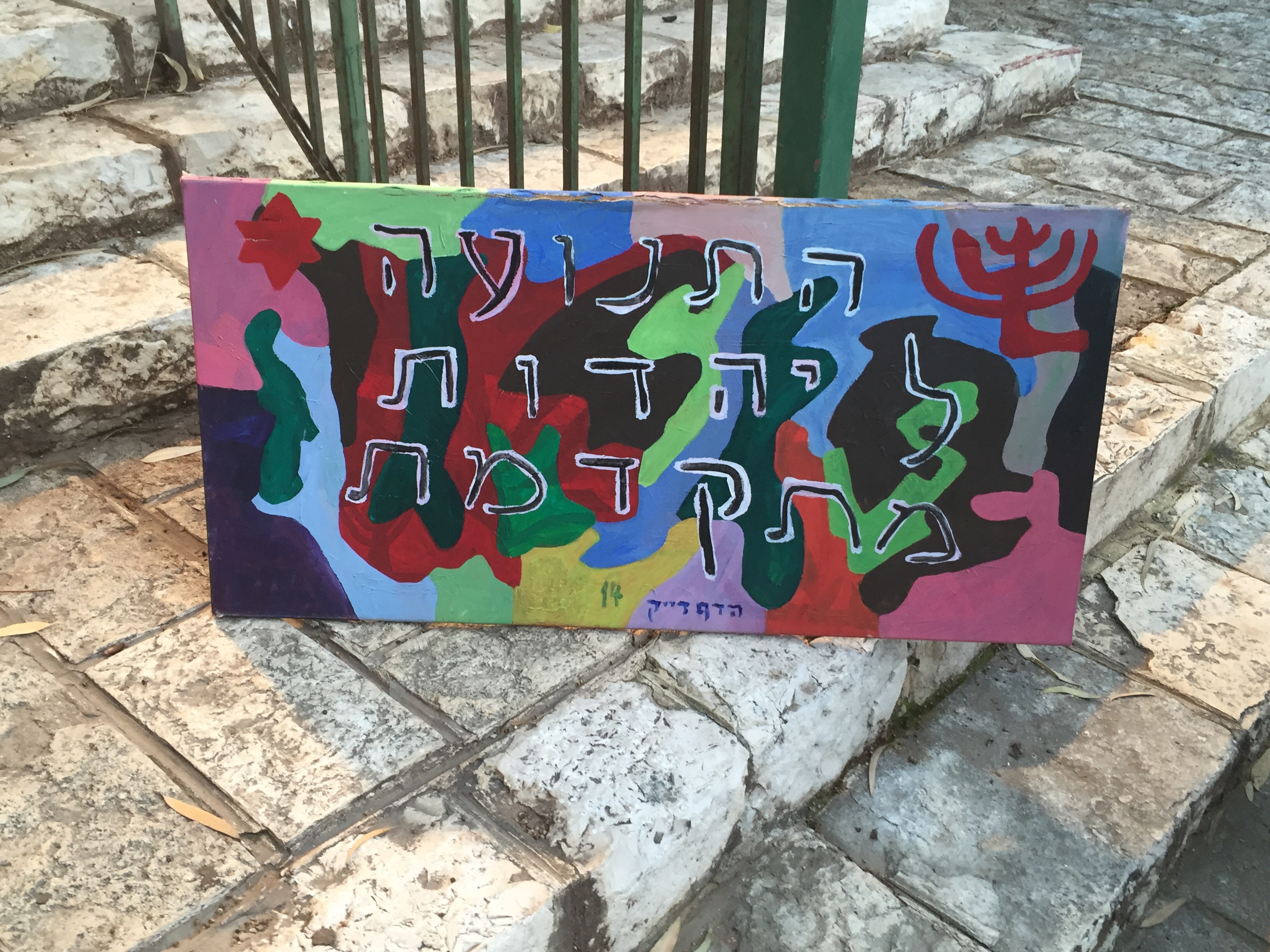
I was delighted to attend Kehillat Halev in central Tel Aviv. We walked into the space, a senior day center the congregation rents from the municipality of Tel Aviv, and were welcomed warmly. Israelis from newborn to senior come each week to this congregation and bring in Shabbat with energy, kindness, joy, and amazing music. Rabbi Rotem offered beautiful words of Torah that spoke to my soul, stirring my own prayer, and from the feeling in the room, the prayer of each person.
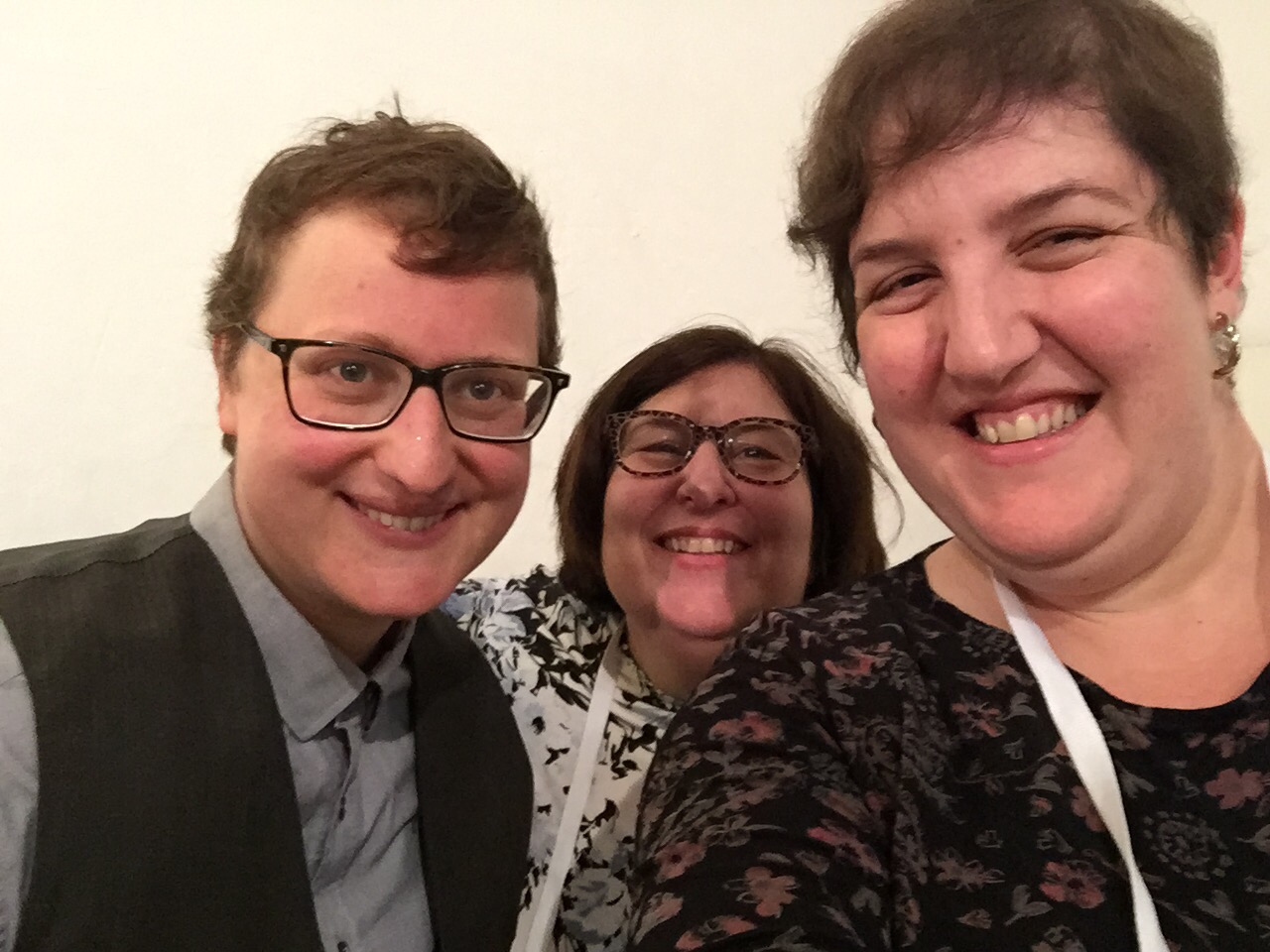
Rabbi Efrat Rotem, Rabbi Denise Eger, Rabbi Ellie Steinman
The community uses a daf T’filah, a handout of the traditional prayers, contemporary reflections, and modern Israeli poetry. Music ranged from Taubman’s Hashkiveinu setting, niggunim, new Israeli songs, and traditional nusach.
The service concluded and I was simultaneously sad and ecstatic. Sad because I don’t know when I will get to celebrate Shabbat with this community again. Ecstatic because this community exists, is thriving, and my soul was filled with the spirit of Shabbat.
I hope you will join me in supporting the communities of the Israeli Reform Movement with our dollars and our Israel trips.
And thank you to Kehillat Halev for a gorgeous Shabbat. I’m sending in my synagogue membership when I get home.
Here’s two minutes of Torah for this week, click here. Shabbat Shalom!
We are trying something new at Temple Beth Hillel. Each week, Rabbi Hronsky or I will be presenting a video called two-minutes of Torah. Here’s the first installment, Parshat Terumah.

Dear Mom,
Tonight I lit a yartzeit candle in your memory. Somehow, almost inexplicably, five years have passed since you died on the 5th of Kislev. Five years have passed in the blink of an eye and in other ways so slowly. I still miss you every day.
Facebook has this new “feature.” It lets you see previous posts from years past. While most of the time it’s funny to read, I need no reminders of the pain and sadness of your unexpected death. People’s words were generous and it was a reminder that even something as simple as a Facebook post can make a difference. I need to remember to be the one who writes those posts.
Last weekend, MY SISTER and I went to Minnesota where we remembered you with MY DAD, family, friends and the Mt. Zion community. You would have loved it because you loved a party. So many people love and miss you. It made my heart full and my eyes tear.
I miss you fiercely, Mom. I love you forever.
—————————–
Blog posts from the past:
Four years-https://rabbisteinman.com/2014/11/26/four-years/
Two years-https://rabbisteinman.com/2012/11/12/730-days/
One year-https://rabbisteinman.com/2011/12/01/5-kislev-is-here/ https://rabbisteinman.com/2011/11/11/one-excruciating-year/
And here’s the dvar Torah I wrote on the occasion of MY MOM’s retirement in May 2010. Some of you might not have known MY MOM. This might give a taste of who she was. https://rabbisteinman.com/2010/05/28/happy-retirement-mommy/

20 years ago it was a Saturday. I was a junior in high school and was in the middle of my brief tenure as a cashier at the local drug store. I’d worked in the morning and I came home and my mom was sitting in front of the TV.
“Oh good, you’re home,” she said.
“Hi Mom.”
“You have to come see this. Yitzhak Rabin was shot,” she said as she pointed to the television screen.
I don’t remember too much of what happened afterwards beyond watching TV curled up next to my mom and crying. I knew that I was watching history unfold before my very eyes and I was so terribly sad. To my 16-year old self Yitzhak Rabin was a beacon of hope. I was preparing for my first trip to Israel that summer and was planning on visiting an Israel that no one had known before, an Israel at peace with most of her neighbors.
My mom and I went to the Twin Cities memorial for Rabin, I think she saw in me my passion for Israel and the sense that her history-loving daughter knew that she was now living through a pivotal time. And somewhere in the recesses of my childhood room there is the newspaper from November 5, 1995, because for whatever reason I felt compelled to save it.
Today when I think about what could have been I get tears in my eyes. And still I refuse to give up hope that Israel will know peace. Because that is one of the profound lessons I learned from Prime Minister Rabin is never to give up hope.
Below is the text of my sermon for Kol Nidre 5776.
Spiritual Refugees, Come Home
There was a woman, Madeline, born 1918 in Pittsburgh, Pennsylvania and she loved sports. An active participant in athletics in ways that were considered appropriate for the era, Madeline especially loved baseball. Madeline was a Jewish girl who lost her mother very young. Her father ran a grocery supply company and she worked in the business when she was finished with school each day. And still, Madeline loved baseball. She met and fell in love with Robert, an aspiring chemist. After they were married, they moved to Champaign, Illinois so Robert could pursue a Ph.D. It wasn’t so easy to be a Jew in small town Illinois. From Champaign the young family moved to Newark, Ohio where Robert found a job after facing much anti-semitism in the hiring process. And still, Madeline loved baseball. Their first child was born in Ohio, followed by a second. A job prospect presented itself in Los Angeles and the family moved. And after a number of years, baseball came to Los Angeles. Madeline had a new baseball team, the Dodgers. Now, it happened on more than one occasion that baseball season and the High Holy Days overlapped and Madeline was faced with a conundrum. There were no recording devices, smartphones, or play-by-play after the game until the next day’s newspaper and this just wouldn’t do when there was a big game for Madeline. Not going to synagogue was not an option. Madeline and her husband and four sons were active members of the congregation and it wouldn’t do not to show up on the High Holy Days. Jews of Madeline’s generation showed up at synagogue. So Madeline crafted a solution. She clipped a small, battery operated radio to her skirt and ran a wire up the back of her blouse and an ear piece to her ear so that she could listen to her Dodgers and be at High Holy Day services. Everyone won. Madeline loved baseball and she loved being Jewish. And I loved her, because I didn’t call her Madeline, I called her Grandma.
This Yom Kippur is one for baseball lovers. It was 50 years ago tomorrow that the first game of the World Series was to take place in Minnesota, Dodgers against the Twins. The best pitcher in baseball was the Dodgers’ Sandy Koufax and he was scheduled to start. There was just one problem: the first day of the World Series was Yom Kippur and Sandy Koufax is a Jew. The question on everyone’s mind was would Sandy Koufax pitch the opening game? The answer of course, was no. Koufax did not play, just as he didn’t play on Rosh Hashanah or Yom Kippur in the preceding ten years. And we know that he would pitch in games 2, 5 and 7 and win the Most Valuable Player in the series that the Dodgers won.
Sandy Koufax, already idolized as a great pitcher, became the hero of the Jewish community. ““There was no hard decision for me,” Koufax said later in an ESPN documentary… “It was just a thing of respect. I wasn’t trying to make a statement, and I had no idea that it would impact that many people.””[i] He showed every person that one could be a great baseball player AND an adherent of Jewish tradition. He was the ideal American Jew: assimilated yet faithful, athletic yet principled.
But Sandy Koufax was not the first great Jewish baseball player. Hank Greenberg, the Detroit Tigers first baseman also refused to play on Yom Kippur in 1934. 81 years ago the United States and the world was in the midst of the depression, anti-semitism was alive not only in the Weimar Republic, but the United States and Hank played in the heart of Henry Ford and Father Charles Coughlin territory, these were two were perhaps the most virulent anti-semites in the country at that time. But baseball fever hit the Motor City with the Tigers in the hunt for the pennant for the first time in 25 years and Hank Greenberg and his .339 batting average lead the way. The Tigers lost that Yom Kippur game and the next day, on the first-ever complete recording of a radio broadcast of a baseball game, “…Ty Tyson, the Detroit broadcaster, noted with a tinge of delight in his voice that Greenberg was back. “Hank was out yesterday observing Yom Kippur,” he said. “And I believe undoubtedly, his big bat was missed out there.””[ii]
These two great Jewish baseball players are the stuff of legends. But tonight, I want to talk with you about a different baseball player. This player, Caleb Summers, will be an MLB prospect in 2020. A lefty like Greenberg and Koufax, Caleb is already honing his skills. He plays baseball in every season, attends showcases, and meets regularly with a pitching coach, a hitting coach and somehow finds time to go to school, too. The problem is that Caleb is 13 and this year, 5776 should be the year Caleb is called to the Torah for the first time as a bar Mitzvah, except Caleb’s been too busy playing ball for Judaism. What if Caleb makes it to the majors and is confronted with the choice of observing Yom Kippur or pitching in the World Series? I shudder to think about the choice he might make. I worry for Caleb and the kids like him that we all know. Caleb is a spiritual refugee.[iii]
A spiritual refugee is a person who flees looking for a spiritual home, someone running from self-help book to self-help book, from EST to Landmark, from the latest workout craze to the next, or focuses on one activity almost to obsession in order to fill up the spiritual emptiness deep inside. Material possessions and casual relationships don’t fill the void. Neither do low ERAs, names in spotlights, or acceptance letters. Spiritual refugee adults do not have the skills and experiences necessary to have a sense of awe and wonder, mystery about the world, God or Judaism because they weren’t provided for us or we didn’t learn them. And now, we are raising a generation of children who are also lost because they are not learning these skills through studying and living their Judaism.
We all know a Caleb Summers. He or she might not play baseball, she might be a gymnast, or an aspiring actor or dancer, a soccer player, or a student so devoted to his studies only activities that will assure admission to an Ivy league school are permitted. Sports, music lessons, and scouting teach our children a lot of important skills and so does our Jewish tradition. It is time to set some priorities and Judaism must be one of them. Caleb might not always be able to throw a baseball 95 miles per hour, he will always be a Jew.
I see people like Caleb or his parents in my office all the time, often when I’m wearing my kippah as Director of Religious Education here at TBH. Just the other day Ruth came to my office to explain why her son will not be able to continue in religious school. Ruth’s son, a 2nd grader is already overwhelmed with homework and between soccer and scouting there are just too many extra-curricular activities and Religious School just isn’t important enough. While I am the first to admit that Religious School is not a perfect solution, it is better than nothing. Jewish tradition has much to teach about living a life of meaning, holiness and study and nourishing the soul. Every time a parent, grandparent, or member of our congregation says that religious school or membership at TBH is not a priority they’re joining the pilgrimage of refugees searching for the next best, most convenient thing. And every time this conversation takes place, it breaks my heart.
Last year I told you the story of another spiritual refugee, Franz Rosenzweig. On Kol Nidre 5674, 1913, Rosenzweig entered a small Orthodox synagogue in Berlin for what he expected to be the last time he would attend worship services as a Jew. Rosenzweig … had become convinced, as did many modern Germans of his day, that the path to success and acceptance in German life was as a Christian. He was raised, with modest exposure to Jewish life and Jewish learning. He viewed Judaism as an anachronism – a faith not in touch with the contemporary world of Western Europe. So he decided that he would attend Yom Kippur services to say farewell to his Jewish identity and the Jewish people.
Something entirely unexpected happened to Rosenzweig in that synagogue that night and it changed his life. He wrote a friend: “After prolonged, and I believe, thorough self-examination, I have reversed my decision … I will remain a Jew.”
What he thought he could find in the church only, faith that gives one orientation of the world, he found on that night in the synagogue. His refugee crisis was over. For the rest of his life, Rosenzweig devoted himself to Jewish study and teaching, and became one of the outstanding Jewish thinkers of the twentieth century.[iv]
Tonight, on the holiest night of the year we are sitting among spiritual refugees like Franz Rosenzweig and Caleb Summers, we might even be a spiritual refugee. People are here because someone, a parent, guilt, a partner, a sibling, a friend, brought you here, to this holy place and our sacred community, welcome.
Yom Kippur is the holiday of spiritual refugees because today we can begin anew and find our spiritual center. This is precisely what the prophet Jonah teaches us. Tomorrow afternoon we will hear his amazing story, but let me give you the Cliff’s Notes. Jonah ben Ammitai gets a call from God who tells him, “arise and go to Nineveh, that great city, and cry out against it, for their wickedness has come up before Me.”[v] Jonah shirked this responsibility and in an effort to get away from what he believes to be God’s dominion, he heads to Jaffa and gets on a boat headed for Tarshish. Once on the boat, the seas get terribly rough, so rocky that the sailors fear the boat will be ripped apart. Each of the fear-filled sailors prayed to his own god and started to throw overboard any extra cargo. In the midst of this tumult, Jonah goes down to the hold of the ship and falls asleep. He is awakened by the commotion of the sailors casting lots and Jonah is thrown overboard and the seas calm and Jonah is swallowed by a fish. He spends three days in the belly of the fish and after three days, offers a prayer of repentance. Jonah is spat out of the fish and ends up on dry land and then, the story starts over again. God calls to Jonah and this time Jonah responds as God requests. Come back tomorrow afternoon to find out how Jonah ends his refugee crisis.
The Book of Jonah teaches us each year that we have the power to end our own refugee crisis. If you were only planning on being with this community tonight, come back tomorrow. Open yourself up to the possibility of prayer, repentance, meditation and soul-stirring music.
If you used to be a member of TBH and now only purchase High Holy Day tickets, come home. Turn your ticket into membership. We need you. The Jewish people need you and we miss you. This congregation, the multitude of schools, programs, and learning opportunities need your physical, spiritual and financial support to continue providing for this generation and the next. If your children or grandchildren are of the right age, come to talk with me after Yom Kippur about signing them up for Religious School and make it a priority in the hectic weekly schedule. Remember they may not become an Olympian, but they will always be a Jew. Don’t we want our children and grandchildren have the skills to be successful mensches? To make choices like Rosenzweig, Greenberg and Koufax?
Most of all stop running away. Whether or not you believe in God or a higher power, or a force that connects all life in the universe or the whole God-thing doesn’t work for you, the Jewish people need you. We need you in our organizations and institutions to ensure that the beautiful communities we’ve constructed live on. We need you at our services and festivals to celebrate and comfort and live Jewishly. And we need you to be a proud Jew doing whatever it is you do professionally. Who knows? You might be the Hank Greenberg or Sandy Koufax of our generation.
My friends, on this holy night, may the gates of repentance be open for us so that we might be like Jonah the prophet and make true repentance. And may the Caleb Summers in our midst and in the circles of our communities find their way to the stories of Hank Greenberg and Sandy Koufax and my Grandma Madeline and the Jewish community and put an end to the spiritual refugee phenomenon.
G’mar chatimah tovah—May our names be sealed in the Book of Life.
Ken y’hi ratzon.
[i] http://www.jta.org/2015/09/08/life-religion/why-sandy-koufax-sitting-out-a-world-series-game-still-matters-50-years-later
[ii] http://www.usatoday.com/story/sports/mlb/2015/09/17/sandy-koufax-yom-kippur-hank-greenberg/32549633/
[iii] This is a term that I created to describe the phenomenon of many spiritual seekers in our country today.
[iv]. Adapted from a beautiful sermon by Rabbi Howard Jaffe, http://www.templeisaiah.net/Resources/Sermons/Read_Sermons/ArticleId/168/Kol-Nidre-5774-2013-Rabbi-Howard-Jaffe.aspx.
[v] Jonah, 1:2.
Happy New Year! Please follow this link to read my Rosh Hashanah morning sermon.
Yesterday the Supreme Court of the United States heard oral arguments about the freedom to marry in this country. Now, we wait. This is a psalm I crafted in 2013 when SCOTUS heard the Prop 8 and DOMA cases and again, we waited. Please share this with attribution as appropriate.
A Waiting Psalm (an interpretation of Psalm 118)
By Rabbi Eleanor Steinman
In the narrowness of waiting I called upon the Source of Life; the Source answered me, and set me free.
God is on my side, the side of equality and justice; I will not fear; what can another human being do to me?
God takes my part with those who help me; therefore I shall gaze upon those who disagree with me.
For it is better to take refuge in the Eternal than to put confidence in human beings.
It is better to take refuge in God than to put confidence in those sitting upon thrones.
All naysayers surround me; but in the name of God I will not allow their rhetoric to enter my consciousness.
They surround me; indeed, they surround me; but in the name of God I will pay them no heed.
They surround me like bees; they are quenched like a fire of thorns; for in the name of the Holy One I will hold fast to my belief in equality for all
You, the one I disagree with, pushed me hard that I might fall; but God helps me.
The Eternal One is my strength and song, and my faith has become my salvation.
The voice of rejoicing and salvation is in the tents of the righteous; the right hand of God does bravely.
The right hand of God is exalted; the right hand of God fortifies me in this time of waiting.
You are my God, and I will praise you; you are my God, I will exalt you.
O give thanks to the Eternal One; for God is good; God’s loving kindness endures for ever.
Amen. Selah.
The Psalmist wrote, “this is the day the Eternal has made, let us rejoice in it” (Ps. 118:24).
Today at the CCAR convention has been dedicated to human rights. As part of raising awareness, there was Ali apanel to commemorate the 25th anniversary of the CCAR’s move to accept gay and lesbian rabbis. 25 years is both a long and short time. Rabbi Yoel Kahn opened a program called, “Celebrating change on the 25th anniversary of CCAR’s resolution on homosexuality and the rabbinate” with a history and a sharing of some of his own story while teaching Torah, his Torah. I hope that Rabbi Kahn’s words will be made available and published widely for they are and were completely inspiring, informative, and emotional.
This afternoon, Rev. Dr. William Barber II addressed the conference about a myriad of issues, voting rights, health care, mass incarceration, poverty, and the erosion of equal protection under the law. If you do not yet know about the moral Monday movement in North Carolina, time to do some research.
The day also included a transitionin leadership of the conference. The new board was installed and Rabbi Denise L. Eger took on the mantle of the presidency of the conference. Rabbi Eger is a talented rabbi, a passionate preacher, and works tirelessly for human rigthts for all. To say that I am proud is an understatement. המבין יבין – those who know, know.
This was a day of much rejoicing. I can’t wait for tomorrow.
 Rabbi Eleanor Steinman