Immediate action needed!

This is from ARZACanada.  They’ve made it really easy to do something very important.  If you’re not in Canada, please follow this link.

Take Action – Send a Letter to Prime Minister Binyamin Netanyahu Please cut and paste the following text in an e-mail to Prime Minister Netanyahu, with a copy to Israeli Ambassador to Canada Miriam Ziv, and Consul General Amir Gissin.

To: Prime.Minister’sOffice@it.pmo.gov.il
CC:  info@ottawa.mfa.gov.il
cgsec@toronto.mfa.gov.il
The Honorable Benjamin Netanyahu
Prime Minister of Israel
Office of the Prime Minister
Jerusalem, Israel
Dear Prime Minister Netanyahu,We write to request your immediate intervention to prevent passage of the legislation being brought forward by MK David Rotem.

We are deeply concerned about the intention to grant the Chief Rabbinate sole control over conversion in Israel.  Such legislation would be an open attack on the legitimacy of non-Orthodox Jewry, which composes the majority of world Jewry.


While we are supportive of efforts to create greater accessibility to conversion courts in Israel, the overall impact of the Rotem Bill will set back these efforts. Should this bill be enacted, it will exacerbate a widening gap between Diaspora and Israel communities, which we are working very hard to avoid.
Therefore, we believe it is imperative that you, as leader of Israel, and as one who cares deeply about the well-being of Klal Yisrael, intervene and urge immediate withdrawal of this bill.
Sincerely,

Posted in Uncategorized | Leave a comment

They arrested the Torah

Anat Hoffman clutches the Torah scroll

And real life hero, Anat Hoffman.  That’s right.  The Jerusalem police force arrested Anat Hoffman on Rosh Chodesh Av, Monday, July 12, for carrying a Torah scroll at the Kotel plaza.

You can read about it from many different perspectives here, here, and here.  My classmate and colleague, Leah Berkowitz also took this video. 

Anat has been banned from the Kotel for 30 days.  Fortunately for all of us, she is coming to Toronto and will be speaking from the bima at Temple Sinai on Shabbat morning at 10am.

Please go to the Women of the Wall website.  On the bottom left there are a number of actions that can be taken, that must be taken.

As if all of this wasn’t enough.  The Rotem conversion bill went before the Knesset.  Please sign this petition in support of liberal Jewry.

There’s work to be done!

Posted in Uncategorized | 1 Comment

Hasta luego

Blogosphere, I am going to be away for two weeks and am taking a vacation from blogging.

See you on the other side…

Posted in Uncategorized | Leave a comment

How to spend 1 billion dollars

Glad it wasn't like this for URJ biennial!

You might not be aware (and ‘you’ would definitely not be living in Toronto if this is the case) that the G20 begins this coming weekend.  All of downtown Toronto has been transformed into a security zone, it seems.  Last night I was lucky enough to go to the Rogers Centre for the Jays v. Cardinals and downtown was deserted except for the groups of cops.  (What do you call a group of cops standing around?  A gaggle is geese…)  The protests are apparently under way.  People who work downtown are being advised to stay away or to come to work in street clothes.

Apparently over 1 billion has been spent to keep everyone safe.  We should expect highways to be closed down for up to 45 minutes at a time.  I live well north of the area where all of this is happening and have no plans to go downtown or anywhere near downtown.  I’ll stick to the suburbs until this is over.

And because I had to look it up, therefore it is probably worthwhile knowledge to share.  The G20 is composed of…

The Group of Twenty Finance Ministers and Central Bank Governors (known as the G-20 and also the G20 or Group of Twenty) is a group of finance ministers and central bank governors from 20 economies: 19 countries plus the European Union. Recently summits meeting at level of Heads of government have been introduced. The 2010 chair country of the G-20 is South Korea.

Countries included are: South Africa, Mexico, Canada, USA, Argentina, Brazil, China, Japan, South Korea, India, Indonesia, Saudi Arabia, EU, France, Germany, Russia, Italy, UK, Turkey and Australia.

This list is oddly similar to the World Cup qualifying teams… hmmm.

Here’s a map to show the security zone. 

They’re projecting that the downtown businesses will lost $1 billion in revenue though this will not be measurable or be recovered at any point.

If anyone wanted my opinion on how to spend $1 billion, well, I can think of lots of ways and places.  It definitely wouldn’t be on security for a bunch of people in Toronto.

Posted in Uncategorized | Leave a comment

Jews and Venice

And by Venice I mean Italy not California.  An easy thing to confuse.

When I was a first-year student at Brandeis I took this awesome class called, “Merchants, Moneylenders and the Ghetti of Venice” taught by Dr. Benjamin Ravid who is an expert in this field.  Needless to say the class was fascinating though I was totally ill-equipped in my first semester at university for such an intensive, seminar style course.  Fortunately, I had opportunity to travel to Venice after my senior year, though only for one day, and tour the Jewish Quarter.

I am resisting every urge to go into a lengthy history lesson about Venice and the pivotal role of this community in post-inquisition Europe (Venice is one of the first stops on the way to the Levant/Ottoman Empire where many Jews continued on).

So, instead, I will just encourage you to read this article.  If you have opportunity to get to Venice, definitely stop in the Jewish quarter (and then have some gelato for me anywhere in Italy).  It is nice that there is a Chabad presence in Venice and I, or course encourage any liberal Jewish visitor to seek out the appropriate organizations that will meet her/his needs.  Regardless, there is very important history and culture of our people in Venice!  Go and see and learn.

Posted in Uncategorized | 1 Comment

Real life heroes

With the World Cup on in the background, I just read of the passing of Manute Bol.  You can read an obituary, here.  I don’t know much about Bol beyond the basketball court but it seems after his career in the NBA ended his real work began.  Hailing from Sudan, he did lots of work to bring peace to the region torn apart in horrendous armed conflict.

I wonder where this type of hero is?  With the world’s attention on the pitch in South Africa are there players who are planning on making the world better when their professional career comes to an end?  I hear lots of people around me idealizing hockey stars, I do live in Canada after all.  Are there organizations they support that go beyond the rink?  How about in addition to listing stats relevant to the game we could also learn about the work people are doing so that we can idolize the talents not just in the professional sporting arena?

I don’t mind when professional athletes have flaws, they are human after all.  I do not condone their behavior when they do things that are illegal or are things we do not want our children to know about.  What about the player who makes the most assists and doesn’t score all the goals or points?

I guess in the end I’m still holding out for a hero.

Posted in Uncategorized | Leave a comment

Who gets to make Jews?

Recently, I came across this article.  Conversions in Israel are a major issue not only for the Jews living there, for the entire Jewish people.  At the time of the founding of the State of Israel, David Ben-Gurion made an agreement with the Orthodox rabbinate that they could run the affairs of state.  (I’m summarizing greatly).  Now, 62 years later it is time for the government of Israel to eliminate the control of the Orthodox rabbinate.  A summary of how we got to this place is here.

Posted in Uncategorized | Leave a comment

Do you buy produce?

Cantor Katie Oringel and Farmer Daniel Hoffman

What would bring multiple generations of community together, embed Jewish values, and enable social justice values in one place?  Food, food access, healthy food choices, and the environment are clear issues in the Greater Toronto Area (GTA).  Temple Sinai is located in the middle of what some call, the doughnut of poverty.  I like to think of it as a bagel of poverty, myself.  There seemed to be opportunity knowing this.
Through meeting with various community groups members of the Social Action Committee (SAC) and I met Daniel Hoffman.  Daniel is a social worker by training and started an organization called The Cutting Veg.
The Cutting Veg runs Community Supported Agriculture (CSA) programs and it seemed this would meet several of Temple Sinai’s goals.  Daniel describes a CSA as, “a mutually beneficial partnership in which individuals or families receive fresh, local, organically grown produce weekly, while supporting our local farmers and sustainable growing practices.”

The best asparagus I have ever tasted.

The SAC gathered together and with the help of Daniel, started to recruit members for our CSA.  We tabled during religious school, went to various committees including the Board of Trustees, created a facebook group and used our regular temple publications to recruit.  The CSA selected the name Pri Adamah, fruits of the earth.  I spoke about Pri Adamah, our CSA, on the first morning of Passover as well.  Our goal was to have a minimum of 50 families by the middle of the farming season.
Some of the reasons we like The Cutting Veg as a congregation is because of a special Tzedakah component.  The Cutting Veg makes a commitment to tzedakah and any member of Pri Adamah is also able to donate any produce that is not picked up to a local youth shelter.  There, the food is used in cooking classes.  We’re also hoping that the connection between Temple Sinai and the youth shelter will reap many benefits.  Three weeks in we are already seeing a partnership emerging.
Our CSA works on a point system.  A large share is 18 points per week, a regular share is 13 points per week.  Each individual (or if a shareholder is two households and splitting) gets to pick their own produce based upon the point values.  The entire enterprise is run on the honor system and works quite well.
The Cutting Veg asks for members of CSAs to think about volunteering on the farm.  In addition, we have access to the farm and our nursery school and young families group are planning trips in the fall.  During the CSA pickup times we need volunteers and already we’re finding that share members are sticking around the tent on temple property to share recipes, learn one anothers’ names and create community.

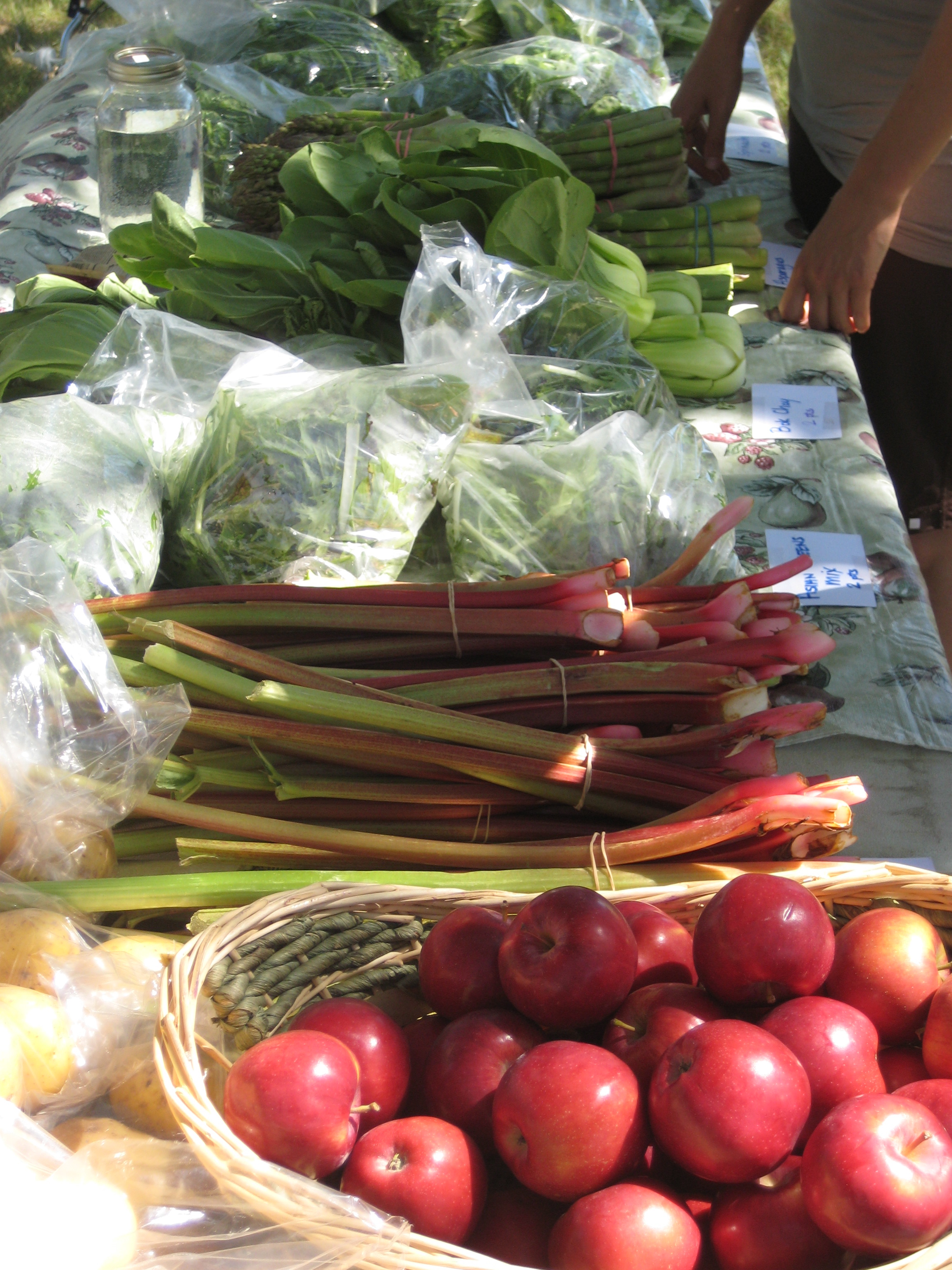
Selections from our first week

I’m happy to report that at the end of business on the first day, Pri Adamah had 54 shareholders.  Many came from the congregation, others are people in the neighborhood interested in organic, local produce.  We’ve had two successful weeks of Pri Adamah.  Already I’ve feasted on spinach, green garlic, green onion, snap peas, asparagus, apples, rhubarb, peppermint, potatoes, and kale (also available where radishes, turnips, bok choy, asian mix greens, salad greens and herbs).  Members have posted demonstration videos of recipes.  Several have mentioned that they noticed they were eating at home and cooking more.

Going forward there is still a lot to be done.  As mentioned above, we’re already seeing an emerging partnership with the youth shelter.  There are other things that they need and we are looking to coordinate drives through temple.  The SAC is considering printing CSA bags with our logo as a means of marketing.  We are also hoping to engage even more community members, perhaps people who are growing things on their own.  We have launched a blog which we invite you to visit and comment or ask us questions.  The plan is to highlight CSA members and gardeners as well as lots of Jewish content.

Pri Adamah is also an opportunity for community outreach.  For our neighbors we hope that we’re providing something that is useful to them.  Many people are coming onto Temple Sinai property for the ‘right’ sorts of reasons and if they’re considering joining a synagogue our doors are open. The Temple Sinai is well aware that there are many learning opportunities around our CSA as well.  Food ethics are a big issue in the Jewish community.  It is also an area of personal interest for me so I’m hoping that there will be a chance to do some adult education around this subject.

If you have more questions about how to start a CSA of your own, there are a lot of great resources out there and I’m happy to help point you in the right direction.  If you’re in the Toronto area you are welcome to join Pri Adamah!  You can download a registration form or come on Tuesday from 2:30-6:30 to Temple Sinai with your checkbook in hand.

I love Pri Adamah because it enables me and all of the shareholders to live our values while nourishing our bodies.  I hope you think about joining a CSA or starting your own.

Betay’avon!

Posted in Uncategorized | Leave a comment

For the love of the game

Last week I was completely inspired to write a sermon after watching Magic & Bird, an incredible documentary that traces the rivalry between these two players from their earliest days playing against one another in the NCAA finals.  These two phenomenal players, both leaders in their own unique way changed the NBA forever.  I had this great idea to use Bird and Magic as different types of leaders and Aaron and the selection of the Cohenim.

But I digress.

I am a Lakers fan through and through.  I remember the rivalry and through the magic of memory only recall the Lakers being victorious.  I know the starting five.  Magic, Kareem, James Worthy, AC Green, and Byron Scott.  Michael Cooper was brought in whenever a three-point shot was required (or as the shooting guard).  I know that these players had personal faults and flaws.  As a young kid, it didn’t matter.  They flew through the air and seemed to make baskets from nowhere.

In fairness, I remember plenty of the Celtics players, too.  Bird, Ainge, Parish, McHale and someone else.  Four of five isn’t bad.

I highly recommend that you see Magic & Bird.  It is an inspiring story of two players who got to the top of their game through practice and even found friendship when the spotlights were turned off and it was just Larry and Earvin.  If you’re not convinced yet, just watch it and then talk to me.

Oh and GO LAKERS!

——

Speaking of a Lakers v. Celtics rivalry…  I think the Celtics have a new littlest fan who was born on Friday to Rabbi T.  and Dr. America.  All are healthy!

Posted in Uncategorized | 1 Comment

Let’s play ball…

Though it isn’t as big of a deal in North America as pretty much anywhere else, it is world cup time!  The US team isn’t a favorite and the Canadian team didn’t even qualify.  Here are 2 interesting articles from Slate about the games and the differences between the US and I think Canada and the rest of the world.  I definitely plan on watching soccer and I don’t have a favorite team.  Do you?

The Loneliness of the American Soccer FanThe world’s most popular sport is on the rise in the United States—and my neighbors still couldn’t care less about the World Cup.

By Daniel GrossPosted Thursday, June 10, 2010, at 12:38 PM ETAmerican soccer fans. Click image to expand.Being a soccer fan at World Cup time in America is a little like being Jewish in December in a small town in the Midwest. You sense that something big is going on around you, but you’re not really a part of it. And the thing you’re celebrating and enjoying is either ignored or misunderstood by your friends, peers, and neighbors. It can be a lonely time. But the World Cup is much bigger than Christmas. After all, only a couple of billion people in the world celebrate Christmas; the World Cup is likely to garner the attention of a much larger audience. Yet in the world’s largest and most important sports competition, the American team, and the American audience, is a marginal, bit player. And for those of us who love the game of soccer and the World Cup, and for the few of us who followed the ups and downs of Landon Donovan’s career, these next couple weeks are likely to be bittersweet.

Of course, it’s getting less lonely. The United States has a growing soccer culture, thanks in part to the rise and growth of MLS. The atmosphere at games in Seattle and Toronto is quasi-European, with crowded stadiums and singing fans holding up scarves. A huge, partisan crowd showed up for the U.S. national team’s final send-off game against Turkey in Philadelphia. But as a rule, the world game remains a niche product here. Television ratings for MLS and U.S. national team games are minuscule. When Team USA plays World Cup qualifiers at home, it’s common for American fans to be outnumbered and outshouted by Costa Ricans, Mexicans, Guatemalans, Hondurans, whoever. Truth be told, there hasn’t been all that much to cheer for. In the 2002 World Cup, the United States made it out of its four-team round-robin group and whacked archrival Mexico in an exhilarating 2-0 game before going out to Germany in the quarterfinals. But the 2006 World Cup campaign essentially ended before it began, with the United States falling behind the Czech Republic in the fifth minute in the first game.

Because of the nation’s historical incompetence at international soccer, Americans generally look at the World Cup the same way they look at other foreign phenomena like sovereign wealth funds, Bollywood, and China—as a potential marketing bonanza. The Wall Street Journal and other organs of the financial press have been filled with articles about the opportunities for consumer products, brands, and media. The international soccer community, likewise, sees America less as a budding soccer power than as a potential financial bonanza—why else would FIFA consider giving the United States the World Cup for a second time?

As a result, if you’re interested in the game, and particularly interested in the U.S. team, you really don’t have that many people talk to. At a recent soccer practice, one of the other dads noted that his son wanted a jersey for some guy whose name he couldn’t remember but who might play for a Spanish team. “Lionel Messi?” I asked. From the lack of recognition on his face, I realized I may as well have said “Lionel Trilling?” I wanted to shout: “You know, the best player in the world? The mite from Argentina who moves faster with the ball than without it, whose low center of gravity lets him ride off tackles from much larger defenders, who schools the opposition the way Michael Jordan used to, who in April scored four goals against Arsenal—against ARSENAL, for god’s sakes!—in a Champions League game, who plays for Barcelona, possibly the most awesome and elegant club in the world, a team that gives its shirt sponsorship to UNICEF rather than selling it to some awful corporation? You mean that guy?” But what was the point? Talking with my neighbors about Lionel Messi would be like trying to engage a group of Amish farmers in a discussion about the merits of the 2011 Porsche Carrera.

Oh, sure, you can find other enthusiasts. A few Slate colleagues pass around YouTube links to the latest sick goal. Urban hipsters are obliged to show some interest the game, the same way they do in CSAs, and facial hair (for men) and yoga (for women). On the Internet, there’s the high-brow crew over at the New Republic, (which features an ad for a book from Cornell University press on Spartak Moscow), the fine blogs No Short Corners and Yanks Abroad, and a rising volume of press coverage. But there’s nothing like the volume and sophistication of stuff our frères at Slate.fr are doing. If you want to follow the game, wince with every missed shot, and question coach Bob Bradley’s personnel choices, you’ll have to venture into the fever swamps of BigSoccer.com. There you will find some people who live and die with status updates of defender Oguchi Onyewu’s knee. But they’re only avatars.

Following the U.S. national team in the World Cup is a somewhat solitary endeavor in part because the scheduling doesn’t lend itself to social or family watching. Unlike the Olympics, the World Cup is not scheduled or televised according to U.S. preferences—the last time the quadrennial tournament was staged in the Western hemisphere was 1994. To watch the United States’ opening game in the 2002 World Cup, I had to go to the Irish pub across from my New York apartment at 4 a.m. This year the schedule is only slightly better: this Saturday against England at 2:30 p.m. ET, Friday, June 18, against Slovenia at 10 a.m. ET, then Wednesday, June 23, at 10 a.m. ET, against Algeria. Yes, pubs and sports bars will be showing the games. But how many people will leave work, or take the day off, or skip the Little League game or pool party, to sit indoors and watch a soccer match? My guess is that when the U.S. plays England, the bars in New York and Los Angeles will be like Condé Nast in the 1990s—overrun with Brits.

I won’t be there. On Saturday afternoon, I’ll be at a family gathering, one at which I’m confident nobody will be checking scores or talking about the potentially epic matchup with England. I’ll have to tape it and watch it later, most likely alone. At least I’m confident none of my close friends or family members will call, e-mail, or text me with scores or updates, and that I can safely listen to the radio without the result intruding. On the other hand, I might have to shut off my Twitter feed. I follow a few foreigners.

——

The True Story of American SoccerFrom The Thinking Fan’s Guide to the World Cup.

By Dave EggersUpdated Thursday, June 10, 2010, at 6:55 AM ETThe 2010 World Cup marks the U.S.’s sixth consecutive appearance in the world’s pre-eminent soccer tournament. Four years ago, Dave Eggers asked why the game hasn’t quite captured America’s imagination, examining soccer’s history and status in this country through his own experiences following and playing the sport. The original article is reprinted below.

Click image to expand.When children in the United States are very young, they believe that soccer is the most popular sport in the world. They believe this because every single child in America plays soccer. It is a rule that they play, a rule set forth in the same hoary document, displayed in every state capital, that insists that 6-year-olds also pledge allegiance to the flag—a practice which is terrifying to watch, by the way, good lord—and that once a year, they dress as tiny pilgrims with beards fashioned from cotton.

On Saturdays, every flat green space in the continental United States is covered with tiny people in shiny uniforms, chasing the patchwork ball up and down the field, to the delight and consternation of their parents, most of whom have no idea what is happening. The primary force behind all of this is the American Youth Soccer Organization, or AYSO. In the 1970s, AYSO was formed to popularize soccer among the youth of America, and they did this with startling efficiency. Within a few years, soccer was the sport of choice for parents everywhere, particularly those who harbored suspicions that their children had no athletic ability whatsoever.

The beauty of soccer for very young people is that, to create a simulacrum of the game, it requires very little skill. There is no other sport that can bear such incompetence. With soccer, 22 kids can be running around, most of them aimlessly, or picking weeds by the sidelines, or crying for no apparent reason, and yet the game can have the general appearance of an actual soccer match. If there are three or four coordinated kids among the 22 flailing bodies, there will actually be dribbling, a few legal throw-ins, and a couple of times when the ball stretches the back of the net. It will be soccer, more or less.

Because they all play, most of America’s children assume that soccer will always be a part of their lives. When I was 8, playing center midfielder for the undefeated Strikers (coached by the unparalleled Mr. Cooper), I harbored no life expectations other than that I would continue playing center midfielder until such time as I died. It never occurred to me that any of this would change.

Advertisement

//

But at about age 10, something happens to the children of the United States. Soccer is dropped, quickly and unceremoniously, by approximately 88 percent of all young people. The same kids who played at 5, 6, 7, move on to baseball, football, basketball, hockey, field hockey, and, sadly, golf. Shortly thereafter, they stop playing these sports, too, and begin watching these sports on television, including, sadly, golf.

The abandonment of soccer is attributable, in part, to the fact that people of influence in America long believed that soccer was the chosen sport of Communists. When I was 13—this was 1983, long before glasnost, let alone the fall of the wall—I had a gym teacher, who for now we’ll call Moron McCheeby, who made a very compelling link between soccer and the architects of the Iron Curtain. I remember once asking him why there were no days of soccer in his gym units. His face darkened. He took me aside. He explained with quivering, barely mastered rage, that he preferred decent, honest American sports where you used your hands. Sports where one’s hands were not used, he said, were commie sports played by Russians, Poles, Germans, and other commies. To use one’s hands in sports was American, to use one’s feet was the purview of the followers of Marx and Lenin. I believe McCheeby went on to lecture widely on the subject.

It was, by most accounts, 1986 when the residents of the United States became aware of the thing called the World Cup. Isolated reports came from foreign correspondents, and we were frightened by these reports, worried about domino effects, and wondered aloud if the trend was something we could stop by placing a certain number of military advisers in Cologne or Marseilles. Then, in 1990, we realized that the World Cup might happen every four years, with or without us.

At the same time, high-school soccer was booming in the suburbs of Chicago, due in large part to an influx of foreign exchange students.

My own high-school team was ridiculously good by the standards of the day, stacked as it was with extraordinary players from other places. I can still remember the name of the forward who came from, I think, Rome: Alessandro Dazza. He was the best on the team, just ahead of Carlos Gutierrez (not his real name), who hailed from Spain and played midfield. Our best defender was a Vietnamese-American student named Tuan, and there was also Paul Beaupre, who was actually from our own WASP-filled town, but whose name sounded French. We were expected to win State, but we did not come very close. Homewood-Flossmoor, we heard, had a pair of twins from Brazil.

Posted in Uncategorized | Leave a comment