
First there was clergy burnout.
Then there was the reality of houses of worship becoming places for entertainment instead of or in addition to meaning.
And then there’s Rabbi Laura Geller hitting the nail on the head.
What do you think?
First there was clergy burnout.
Then there was the reality of houses of worship becoming places for entertainment instead of or in addition to meaning.
And then there’s Rabbi Laura Geller hitting the nail on the head.
What do you think?
 The various rabbis who articulated their understanding of what it means to be a rabbi today in North America are pretty much right on the money.
In my own words, a rabbi’s role is to be a spiritual guide. To mark sacred moments Jewishly, and to increase holiness in the world through teaching, preaching, modeling, and doing. I think that the rabbi today must be prophet-like in that rabbis (and all clergy for that matter) must tune their ear to the silent cry of the widow, orphan, stranger and other in our midst. Without being political, it is up to clergy to speak to the ethical truths of our rich tradition. Rabbis get to also be human beings. Fallible, thoughtful, with a life filled with a variety of interests.
On a related note, it is of concern to me when I read articles like this. And many people thought I should read it since it was forwarded to me! Even responses like this give me food for thought. How is being a clergy member different then it used to be? And what will it be like going forward?
Dear reader,
I saw this very interesting compilation of explanation (divided by Jewish denomination) in Moment. The question is asked, ‘what is the rabbi’s role in modern [North] America?’
Please read it, and let me know which of the opinions you like best, or find the most accurate. I will give my opinion tomorrow.
Ask the Rabbis, a forum that appears in each issue, provides a rare opportunity to read the opinions of rabbis from across the spectrum of Judaism. Its purpose is to illuminate the diversity within Jewish thinking and create a cross-denominational discussion that leads to deeper understanding.
What is the Rabbi’s Role in Modern America?
Independent
The rabbi’s role today should be no different than it was yesterday: to teach. Not give sermons about current events and politics but to re-introduce the richness of our tradition to the hordes of thirsty congregants who crawl reluctantly to shul desperate for a smidgen of a chicken peck’s worth of spiritual grain. They’re starving out there, and in too many instances rabbis have become spiffy CEOs instead of disheveled rebbes. The rise of the new gods, Google and Wikipedia, now challenges us further, offering easily accessible information on Judaism that does not require synagogue attendance. We have today more rabbis who in turn have less time, and in many cases have ceased studying, thus possessing less teachings to share. Gird thy loins, O thou who callest thyself Rabbi. Get thee forth, fifth and sixth, and climb back up the Holy Mountain to receive once more and to give twice as much, lest the people murmur and return to Egypt (instead of your Israel tour).
Rabbi Gershon Winkler, Walking Stick Foundation, Thousand Oaks, CA
Humanist
The classical role of the rabbi as teacher and philosophical guide persists, but more rabbis are taking on additional job duties as community organizer, fundraiser, if not CEO. In some congregations and organizations we can add the job of webmaster. The Internet has taken over all aspects of our lives, no less our Jewish ones, and is a boon, not a threat. If we believe in promoting Jewish literacy for all Jews and not keeping this the private privilege of rabbis who will mediate for the people, then the web is an incredible tool for spreading knowledge, a ready resource for quick answers as well as learned essays. Our job, no different than it was before, is to point people in the right direction, to reliable sources and useful readings. The web has also become the portal that newcomers are likely to visit before even visiting our congregations or organizations. They can “shul-hop” without leaving home. It is critical that our own websites convey the excitement, principles and unique quality of our institutions to fleeting visitors.
Rabbi Peter Schweitzer, The City Congregation for Humanistic Judaism, New York, NY
Renewal
I am so grateful to be a rabbi today in America, where Judaism is being renewed both with reverence for the past and creative love for the future. I wake up each day and ask God, “How can I be useful? How can I serve?” And then I listen, opening the eyes of my heart. I see the role of rabbi as a spiritual “calling.” I am called to bring healing, inspiration, pleasure and meaning, first to myself and then to this thirsting world. I do this by drawing on the riches of my inheritance. Our ancestors bequeathed treasure upon treasure in the form of story, law, culture, music, the Holy Days, Shabbat, prayer and, most importantly, a language with which to talk about the great mysteries of life. My job is to receive these treasures and pass them on in forms that are compelling and beautiful. I address these challenges as teacher, spiritual leader, social activist, healer, shaman, performer of ritual, facilitator, prayer leader, comforter, scholar, ethicist, historian, community organizer, social worker, prophet, philosopher, theologian, resource-person, fundraiser, administrator, guardian of tradition, Kabbalist, mentor. Jewish information may be readily available on the Internet but living a Jewish life depends on more than information. My role as a rabbi is to glean wisdom, seek the essential and re-interpret Torah in ways that speak to this world that I love.
Rabbi Shefa Gold, C-DEEP: Center for Devotional, Energy and Ecstatic Practice, Jemez Springs, NM
Reconstructionist
When someone says “I need a rabbi,” what do they mean? Amid personal challenges, they need a spiritual counselor. For a Jewish legal question, they need a scholar. If they feel adrift, an activist or organizer could be useful. Rabbis today perform all these functions and many more but so do other people. The difference between rabbis and lay people, when discernible, is of levels of Jewish learning, of training, of immersion, not of kind. Rabbis may have the title and office, and hopefully the time and the commitment, but knowledge and passion are available to all. Unlike many other religious traditions, Judaism is not sacramental—anyone can lead prayer, officiate life cycle events, interpret texts and lead a community. As rabbi, I hope to be a guide and a goad, steering people toward greater Jewish involvement and empowering them to do what I do: study Torah, visit the sick, facilitate community, support one another, work for justice. These actions are mitzvot, incumbent on all. Still, as Judaism has evolved, so have expectations of the modern rabbinate, summed up in the old adage “to comfort the afflicted and afflict the comfortable.” Rabbis are pastors and prophets, managers and muckrackers, continuity and change-agents. We are co-creators of a covenantal community who need our congregants as much as they ever need us.
Rabbi Fred Scherlinder Dobb, Adat Shalom Reconstructionist Congregation, Bethesda, MD
Reform
For all the mind-bending cultural, social and technological changes that recent decades have brought, the rabbi’s essential and indispensable role remains constant: to teach, to preach, to counsel and to enrich and deepen the significant moments of people’s lives. Indeed, it is this very combination of roles that makes the rabbi’s opportunity unique: to be able to affect the entire person—the mind, the heart and the will, in moments of strength and triumph and in moments of weakness and pain. The deeper the rabbi’s involvement in the lives of the members of the congregational community as trusted friend, as admired fellow traveler and as source of insight and direction, the greater the opportunity to teach, to preach and to comfort. This means that we have the opportunity to offer our people a conception of life in which the needs of the moment and the call of eternity, the requirements of the individual and those of the community are all given their due in the one institution of Jewish life that combines them all in the promise of a life of wholeness. This is, and always has been, the sacred calling of the rabbi.
Rabbi Roger Klein, The Temple-Tifereth Israel, Cleveland, OH
Conservative
A pulpit rabbi should be a leader with a vision. Her vision sets the direction for the congregation’s future. She should seek out lay leaders to join her in creating a compelling and relevant community. We are blessed to live at a time in history when there is a State of Israel. A rabbi should help those around her learn about Israel, creating connections between Jews in the Diaspora and Israel. A rabbi should study Jewish texts regularly. She cannot effectively teach or lead if she is relying only on what she learned in rabbinical school. A rabbi should be prepared to re-examine issues that are challenging the Jewish community. Over time, the needs of the community will change and a wise rabbi will be prepared to change her views. A rabbi should nurture her own spiritual self. In order for a rabbi to help others experience God’s presence in their lives, she must devote time and attention to her relationship with God.
Rabbi Amy Wallk Katz, Temple Beth El, Springfield, MA
Modern Orthodox
We are living through a historic shift in the role of rabbis. As higher education spreads to the masses, people become more secular. Religion (or faith in God) will not disappear, but God is more hidden in this new world. The religious action will be in “secular” activities. Examples: uncovering God’s presence among the poor and oppressed and bringing them faith-motivated social justice; healing the body—the physical icon of God’s presence—by working with the miraculous genetics and bodily systems to cure illness; establishing just and loving relationships with family, friends and all humans because we “fear God” and honor the image of God in every person; giving over information to enable people to make good judgments in everything they do. In the past, people turned to rabbis for authoritative answers from the tradition. Now people feel competent to apply values to their daily work and to their secular (but actually religious) activities. If the rabbi claims authoritative and definitive knowledge and demands obedience, he/she will have little credibility. Nor will threats be effective—i.e. that God has decreed certain actions/rituals and will punish non-compliance. The wise rabbi will shift from stressing institutional authority to serving as teacher, from decider to enabler and seek to persuade by the power of wisdom and to influence by personal role model. Many will serve in non-synagogue settings. Enabler/teacher, role model, conduit of God’s presence—this is the rabbi’s role in the age of secularism.
Rabbi Yitz Greenberg, New York, NY
Sephardi
Many a sage has attempted to define the role of a rabbi with reference to a specific facet of rabbinical duty. They have claimed that the essential function of a rabbi is either teaching the Torah, battling the perpetrators of injustice, comforting the bereaved, visiting the sick or inspiring the weary. I believe that, in fact, all of these components of the rabbi’s job description are the expressions of a single, underlying mission with which he has been charged—namely, to sanctify the name of G-d. When a rabbi teaches Torah, the beauty and majesty of the Creator’s wisdom is made manifest. By the same token, when a rabbi refuses to tolerate persecution, oppression or injustice, and when a rabbi lends a hand to the downtrodden, supports the fallen and remembers the forgotten, he brings recognition to G-d whose Torah inspired him to behave in this manner. Ultimately, the successful rabbi is one who, by his words and deeds, demonstrates an understanding of and commitment to the Path of God which is then studied, imitated and emulated by others.
Rabbi Joshua Maroof, Magen David Sephardic Congregation, Rockville, MD
Chabad
In the United States, labels—including that of rabbi—mean less than anywhere else in the world: Jews are, thank G-d, seeking that which is meaningful to them, presented in an authentic and uncontrived way. The advantage of being a Chabad House or pulpit rabbi is the ability to cultivate growth in a person, a growth compounded by understanding and trust, only developed through consistent contact over an extended period of time. The more experience you have in a given community, the more attuned you are to the crucial subtleties of its members’ needs. As a responder on Chabad.org’s Ask-the-Rabbi team, I am able to meaningfully serve a worldwide congregation while connecting them directly with their own communities. At Chabad at Harvard, the web renders us available to our students and alumni wherever in the space-time continuum they may fall. The Lubavitcher Rebbe taught that every advance in human knowledge is driven by divine providence. Its purpose is to enhance our ability to make our world a place where G-dliness finds a home. The ubiquity of Judaic knowledge on the web is a prime example of this. With the web, Judaic knowledge reaches untold numbers who would never have been connected. People acquire knowledge of Judaic practice on the web and seek out “bricks-and-mortar-rabbis” to participate.
Rabbi Shlomo Yaffe, Scholar-in-Residence, The Chabad House at Harvard, Boston, MA
1. Hooray for Prop 8 being overturned! Yay for Judge Walker and his thoughtful analysis of the case.
2. Way to go Senate and Elena Kagan. There are three women on the Supreme Court now.
3. Shabbat Shalom!

Coffee beans growing in Hawai'i
If you come to my office at TS, you might notice that I have a Keurig K-Cup coffee machine on my desk. Moving this machine from my home to my office has dramatically decreased the number of stops I might make on my way to or from the office for coffee. Yes, I’m saving money. Yes, I’m being a bit more environmentally conscious.
My beloved k-cups (which I buy in boxes of 50 from Costco and only purchase fair-trade I might add), do cause me concern. I realize that I’m producing a bit of waste because of the one-time use of these cups. (I should note that when I was using this machine at home, I most often used this reusable filter). In my office, however, coffee grounds, and the reusable filter did not seem like a practical option.
Then I read this article about how Green Mountain Coffee (where I used to buy my k-cups when living in the country to the south) is trying to make the packaging on the k-cups more green. Thank you Green Mountain Coffee for helping to ease my guilty conscience a bit.
If you would like a cup of coffee, feel free to stop by!
PS – You’re only getting fair trade coffee, right? Perhaps a post for another time!
 I loved shopping at Target. A store that had everything I could possibly need at reasonable prices. One of the stores I miss most since moving to Canada is Target. Until now.
Target Corporation has donated $150,000 to a Minnesota gubernatorial candidate who maintains a clear anti-gay position. Here is a concise story which provides information.
MoveOn.org and Human Rights Campaign have petitions that are easy to sign and send a clear message.
All of this is stemming from a Supreme Court ruling which permits major corporations to contribute to political campaigns. It makes me sad that corporations are willing to support organizations and candidates that discriminate against human rights. It seems to me that individuals have a right to support whomever they choose but publicly traded companies is a completely different story. When Target gives the largest donation to date in support of a candidate who is clearly anti-gay and then says things like, “Target’s support of the GLBT community is unwavering, and inclusiveness remains a core value of our company,” it makes it hard to know who or what to believe.
For now, Target and Best Buy aren’t getting any of my dollars, Canadian or US. If you have thoughts on this issue, please share!

Take A Stand!
The images of Anat Hoffman being led away from the Western Wall are being profoundly misrepresented in the media. Every time Women of the Wall appear in the news, they are presented in the media as a handful of extremist, fanatical and crazy women who are ‘yet again’ provoking a disturbance.
Women of the Wall do not stand alone.
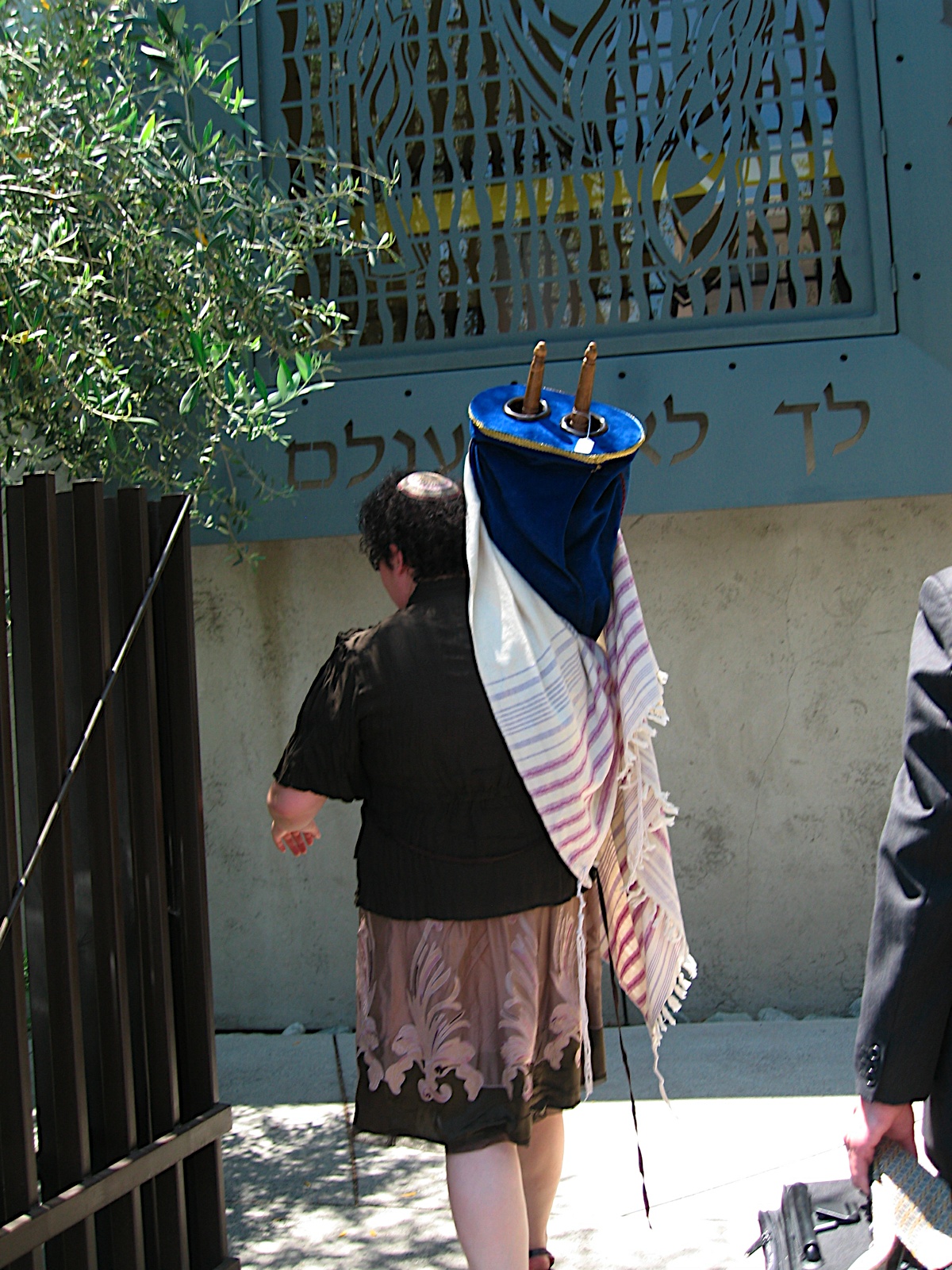
Our daughters and our rabbis, our mothers and our grandmothers, our cantors, our teachers, men and women alike, hold the Torah, read from the Torah, and study the Torah. The sounds of the Women of the Wall do not echo against a silent universe. As they pray, we pray, as they sing, we sing, as they chant, we chant. Daily and weekly, holiday and Shabbat, the voices of millions of women and girls in prayer resound in our synagogues. We pray without disturbance, without fear. Only in Jerusalem do they pray with fear and as criminals.
Let us not limit the image of a woman with a Torah to mug shots and provocative paparazzi photographs in times of crisis! Let us not allow Women of the Wall to stand alone in the struggle to pray and read from the Torah safely and rightfully.
The days and weeks between the 9th of Av and Simchat Torah will be a period of giving testimony of women’s participation in prayer, and especially the Torah. We will inundate the Israeli government and religious leaders with 10,000 images of women teaching, study, learning, reading, embracing Torah Scrolls.
Take this opportunity to send a letter to Israeli government and religious leaders, with a personal statement of your support.
Send pictures of yourself and women from your community with Torah scrolls to Israeli representatives and decision makers. Turn to your family, congregations, community centers, synagogues and any other places where Jews gather and Torah scrolls are stored, and invite women to hold a Torah scroll, saying the following blessing:
“פתח ליבי בתורתך. ברכו שעשני אישה
P’tach libi b’toratecha, Barchu she asni isha
Open my heart to your Torah.
Blessed is the one who made me a woman.”
Click here to upload a picture and email a letter of support addressed to:
● Binyamin Netanyahu, Israeli Prime Minister
● Reuven Rivlin, Speaker of the Knesset
● Tzipi Livni, Head of Kadima and leader of the opposition
● Natan Sharansky, Chairman of the Executive of the Jewish Agency
● Rabbi Shmuel Rabinowitz, Rabbi of the Western Wall and Holy Sites
Sign your name and share this opportunity to stand alongside Women of Wall with friends, family and community members.
Thank you for your time and support.
Apparently I went on a blogging hiatus in July. Now its August and I’m back. While there’s lots of writing to be done for lots of purposes, I hope that this will be a month in which I can regularly post.
Happy Simcoe Day!
Forgive me dear readers, I’ve been so busy with no time to blog. And since today is my day off this isn’t really a blog post. Just an apology and a suggestion to read this article. More soon (I hope!)

This important op-ed was in the New York Times yesterday. It explains the danger of the Rotem bill concisely and clearly so we can all do a better job of explaining the situation to our families and friends. Then of course, everyone should sign this petition!
The Diaspora Need Not Apply
By ALANA NEWHOUSE
Published: July 15, 2010
//
WHO is a Jew? It’s an age-old inquiry, one that has for decades (if not centuries) provoked debate, discussion and too many punch lines to count — all inspired by what many assumed was the question’s essential unanswerability. But if developments this week are any indication, the Israeli parliament, the Knesset, might soon offer an official, surprising answer: almost no one
On Monday, a Knesset committee approved a bill sponsored by David Rotem, a member of the nationalist Yisrael Beiteinu party, that would give the Orthodox rabbinate control of all conversions in Israel. If passed, this legislation would place authority over all Jewish births, marriages and deaths — and, through them, the fundamental questions of Jewish identity — in the hands of a small group of ultra-Orthodox, or Haredi, rabbis.
The move has set in motion a sectarian battle that is not only dividing Israeli society but threatening to sever the vital connection between Israel and the American Jewish diaspora.
The problem is not simply that some of these rabbinical functionaries, who are paid by the state and courted by politicians, are demonstrably corrupt. (To take the most salacious of a slew of examples, an American Haredi rabbi who had become one of the most powerful authorities on the question of conversion resigned from his organization in December after accusations that he solicited phone sex from a hopeful female convert.) Rather, it is that the beliefs of a tiny minority of the world’s Jews are on the verge of becoming the Israeli government’s definition of Judaism, for all Jews.
It is hard to exaggerate the possible ramifications, first and foremost for Jewish Israelis. Rivkah Lubitch, an Orthodox woman who is a lawyer in Israel’s rabbinic court system, painted a harrowing picture of the future in a recent column on the Israeli Web site Ynet.
“Even if you didn’t go to register for marriage, and even if you didn’t go to a rabbinic court for any reason, and even if you didn’t pass by a rabbinic court when you walked down the street — the rabbinic court can summon you, conduct a hearing about your Jewishness and revoke it,” she wrote. “In effect, the entire nation of Israel is presumed to be Not-Jewish — until proven otherwise.”
Why are the rabbis doing this? The process is not being driven, as some say, by a suspicion of new converts — they’re simply a wedge issue. Nor is it, as others argue, a reaction to the influx of Russian Jews, who when they seek permission to wed in Israel are often asked for evidence that their families were registered as Jews in the old Soviet Union.
No, what is driving this process is the desire of a small group of rabbis to expand their authority from narrow questions of conversion to larger questions of Jewish identity. Since what goes for conversion also goes for all other clerical acts, only a few anointed rabbis will be able to determine the authenticity of one’s marriage, divorce, birth, death — and every rite in between.
And lest one imagine that this is just another battle between the more progressive Reform and Conservative denominations and the more observant Orthodox, it must be noted that the criteria used by the rabbinate are driven by internal Haredi politics, not observance. According to the Jewish Week, at one point the number of American rabbis who were officially authorized by the Israeli rabbinate to perform conversions was down to a few dozen. Even if you are Orthodox — and especially if you are Modern Orthodox — your rabbi probably doesn’t make the cut. (Don’t believe it? Go ask him.)
Given that the conversion bill is the latest in a series of similarly motivated efforts, it seems almost useless to note that the stringent approach to Jewish law that the Israeli rabbinate promotes bears little connection to the historical experience and religious practice of the majority of Jewish people over the past two millenniums. It will do little good, too, to point out that it is well outside the consensus established by Hillel — arguably the greatest rabbi in all of rabbinic Judaism and whom, as Joseph Telushkin argues in a forthcoming book, was willing to convert a pagan on the spot, simply because he’d asked.
And it doesn’t help to argue that giving the ultra-Orthodox rabbinate total control over Jewish practice will destroy religious life in Israel just as surely as clerical control hurt the Church of England and the Catholic Church in Spain and France. Or that the Zionist founders, from Herzl to Jabotinsky to Ben-Gurion, all believed passionately in the unity of the Jewish people and the need for a secular state.
But perhaps a more practical rallying cry will work: If this bill passes, future historians will inevitably wonder why, at a critical moment in its history, Israel chose to tell 85 percent of the Jewish diaspora that their rabbis weren’t rabbis and their religious practices were a sham, the conversions of their parents and spouses were invalid, their marriages weren’t legal under Jewish law, and their progeny were a tribe of bastards unfit to marry other Jews.
Why, they will wonder, as Iran raced to build a nuclear bomb to wipe the Jewish state off the map, did the custodians of the 2,000-year-old national dream of the Jewish people choose such a perverse definition of Jewish peoplehood, seemingly calculated to alienate supporters outside its own borders?
And, they will also wonder, what of the quiescence of diaspora Jewry? Many American Jews understandably see Israel as under siege and have not wanted to make things worse; they imagined that internal politicking over conversions and marriages was ephemeral, and would change. But the conversion bill is a sign that this silence was a mistake, for it has been interpreted by Israeli politicians as a green light to throw basic questions of Jewish identity into the pot of coalition politics.
The redemptive history of the Jewish people since the Holocaust has rested on the twin pillars of a strong Israel and a strong diaspora, which have spoken to each other politically and culturally, and whose successes have mutually reinforced the confidence and capacities of the other. Neither the Jewish diaspora nor Israel can afford a split between the two communities — a dystopian possibility that, if this bill passes, could materialize frightfully soon.
Alana Newhouse is the editor in chief of Tablet Magazine, which covers Jewish life and culture.

