As you may know, #blogelul was the brainchild of my colleague, Rabbi Phyllis Sommer. Rabbi Phyllis and Rabbi Michael Sommer’s son SupermanSam is on day zero for a bone marrow transplant to treat the ninja cancer cells in his body. You can read all about SupermanSam on his blog.
At some point tonight SupermanSam will receive donor cells from SuperMensch (his anonymous donor). SuperMensch was on the national bone marrow registry volunteered and was swabbed and with a procedure is able to save another human beings life. Today is the day to join the registry.
Today, this is my prayer.
SupermanSam, may the One who makes wholeness in our world grant you peace, comfort, a sense of lightness and quickly grafting cells tonight and in days and weeks to come. May all of your family members know patience, hope, laughter and the joy of your radiant smile for many, many years to come. Bless your doctors, nurses, therapists and all care givers with gentle hands, open minds and the strength to complete the tasks in order to bring you to full health. As Moses once cried out for his ill sister, Miriam, El Na Refah na La I pray for you, El na Refah na Lo, God please heal you, SupermanSam. Amen.
Since the end of Shabbat much has happened at the Western Wall about the Western Wall. Here is an article that summarizes the situation.
Yesterday, it was reported that Cabinet Minister Avichai Mendelblit has proposed a new solution that counters the Sharansky proposal. Here is an article about Mendelblit’s proposal.
Anat Hoffman, Executive Director of the Israel Religious Action Center explains what is going on. (It is a little hard to hear the beginning because of the wind, stick with it).
Women of the Wall is holding a sit-in. Here is an onsite report:
The Central Conference of American Rabbis, the Reform rabbinic body has issued the following statement:
CCAR Statement Concerning Recent Developments Regarding the Kotel:
The Sharansky proposal, developed in partnership with denominational leaders of American Jewry, envisions “one Western Wall for one Jewish People,” symbolizing that all Jews have a valued and recognized place at the Kotel, in Israel, and in Jewish life.
The fundamental principles of the Sharansky plan are clearly defined and critically important: creating an area for egalitarian/pluralistic prayer to the right of the ramp to the Temple Mount, an area equal in size and elevation to the existing prayer zone; secure, common, and equal physical access to both the gender-segregated and the egalitarian/pluralistic areas on a 24/7/365 basis; common entries to the public plaza leading to all sections; governance of the egalitarian/pluralistic prayer area and the public plaza outside the present prayer areas by a pluralistic body under the aegis of the Jewish Agency, including leaders of liberal Jewish Movements, rather than the present, Orthodox-dominated Western Wall Heritage Foundation; and transforming the WWHF to reflect the diversity of Jewish belief and practice in Israel and among the Jewish People.
While this plan fell considerably short of what the Reform Movement sought, we have expressed willingness to accept its compromises in the interest of shalom bayit.
Solving the issues presented by the Kotel situation is essential to Jewish Unity and Israel’s strategic interests. We urge the Prime Minister’s office, in the strongest possible terms, to commit itself to the Sharansky proposal in its entirety, promptly, publicly, and unequivocally, to formulate both interim and permanent plans consistent with that proposal in partnership with all key stakeholders and to refrain from presenting a proposal until those vital tasks are accomplished.
The steps announced today by Interior Minister Naftali Bennett concerning Robinson’s Arch, whatever their merits, fall far short of the Sharansky proposal in both substance and process. Fortunately, it appears that press reports that the Government was about to release a unilateral plan inconsistent with the Sharansky proposal were erroneous. If the opportunity for a collaborative process and solution is missed and a plan is put forward that diverges in material respects from the Sharansky proposal, it will exacerbate the tensions so many have worked hard to defuse and set back a process in which so much productive effort has been invested.
Rabbi Richard A. Block, President Rabbi Steve Fox, Chief Executive For the CCAR Board of Trustees
Have I mentioned how proud I am to be a member of the CCAR? You can support them (and thereby me and all of my Reform rabbinic colleagues) here.
I make no secret of my support for Women of the Wall, the Israel Religious Action Center and an end to the Western Wall as an Orthodox synagogue.
This is a crucial moment for religious pluralism in Israel.
———-
UPDATE
Here is the statement made jointly by the various organizations of the Reform Movement.
August 25, 2013, New York, NY– In response to Minister of Religious Affairs Naftali Bennett’s announcement today regarding upgrades at the Kotel, the Reform Movement released the following statement:
“The Kotel is a powerful symbol of the Jewish yearning for Israel and for the unity of the Jewish people. As such, it needs to be open and free to all Jews; women and men must be treated equally there.
That is precisely why we joined together with Jews from across the religious spectrum to endorse a plan by Jewish Agency Chairperson Natan Sharansky which, in its entirety, promises full equality for all streams of Judaism at the Kotel.
The temporary platform unveiled today by Minister of Religious Affairs Naftali Bennett, is a gesture of good will, but it is, at best, a very small step forward in the implementation of the full plan for full Jewish equality at the Kotel. Were it to be the first and last step regarding the Kotel, it would create a painful and unnecessary conflict within the Jewish People.
We urge the Prime Minister’s office to maintain its commitment to the Sharansky proposal consistent with a partnership with all key stakeholders.
In the meantime, the Reform Movement insists that no changes will be made in the current legal situation allowing Women of the Wall to pray according to their custom in the Western Wall site.
We hope and pray that 5774 will be a year of ever deepening partnership between the State of Israel and World Jewry in insuring that in Judaism’s holiest place there is room for each and every member of our people to pray freely and openly. May that spirit of respect and inclusion permeate daily life in the Jewish State and in our communities all across the globe.”
ARZA
ARZA Canada
ARZENU
Central Conference of American Rabbis (CCAR)
Hebrew Union College – Jewish Institute of Religion (HUC-JIR)
In an envelope marked: Personal
God addressed me a letter.
In an envelope marked: Personal
I have given my answer.
Mishkan T’filah, p. 165.
Prayer is the easiest thing to do and it is the most difficult thing to do. Many assume that because I am a rabbi prayer is extremely easy for me. This is simply not true. Yes, I do know a lot of information about the history of the prayerbook, the creation of liturgy and why prayers are placed in a particular order and we say certain prayers at certain times. However, prayer is still no easy.
What makes it easier is that I know the words of the prayer book. When I am at services I know what to do. However, those spontaneous prayers that come from the deepest place within are sometimes hard to articulate with words. Because it is hard does not mean one should shy away from it. It is just hard.
I’ve heard that many find Rosh Hashanah and Yom Kippur difficult because of the theologies presented in the liturgy. Guess what? I do, too! However, because I attend services at lots of other times during the year I know that there are many other views of God/Divine than those presented on the High Holidays.
And sometimes (confession forthcoming) clergy need to make decisions about what prayers in which language so it is okay to look through the machzor (prayer book for Rosh Hashanah and Yom Kippur) on your own. That’s right. I’m giving us all permission to read ahead or read something different, as long as we aren’t distracting (don’t read something aloud while everyone in the congregation is reading quietly or read something different aloud while the person next to you is praying following the instructions from the clergy) other people.
Prayer is hard. It can be less hard if you practice.
When I was in the 2nd grade my teacher elected to mark Rev. Dr. Martin Luther King, Jr. day in a unique way. We spent the entire day of learning listening her (and maybe some volunteers) read the entire class a story. Ms. Phillips read a kid-friendly book about Dr. King. The climax of the story, again kid-friendly, was the “I Have a Dream” speech he delivered at the March on Washington for Jobs and Freedom in 1963.
The “I Have a Dream” speech is arguably the most significant piece of oration of the 20th century. Dr. King outlined a vision and inspired hundreds of thousands to work towards that ideal. (At some point during my elementary school education I was required to memorize passages from this speech. Anyone else?)
And 50 years later we still have work to do.
This weekend in Washington, DC there will be an anniversary March on Washington. I know very little about what is planned beyond a lengthy list of sponsorships and I know a few of the speakers. I wonder how this new march will awaken and reawaken the conscience of the American people to see that while we have made progress, we are not there.
As I prepare for the coming new year I am asking myself how will I awaken to the suffering of the people around me? How will I elevate the stories of those who are silenced?
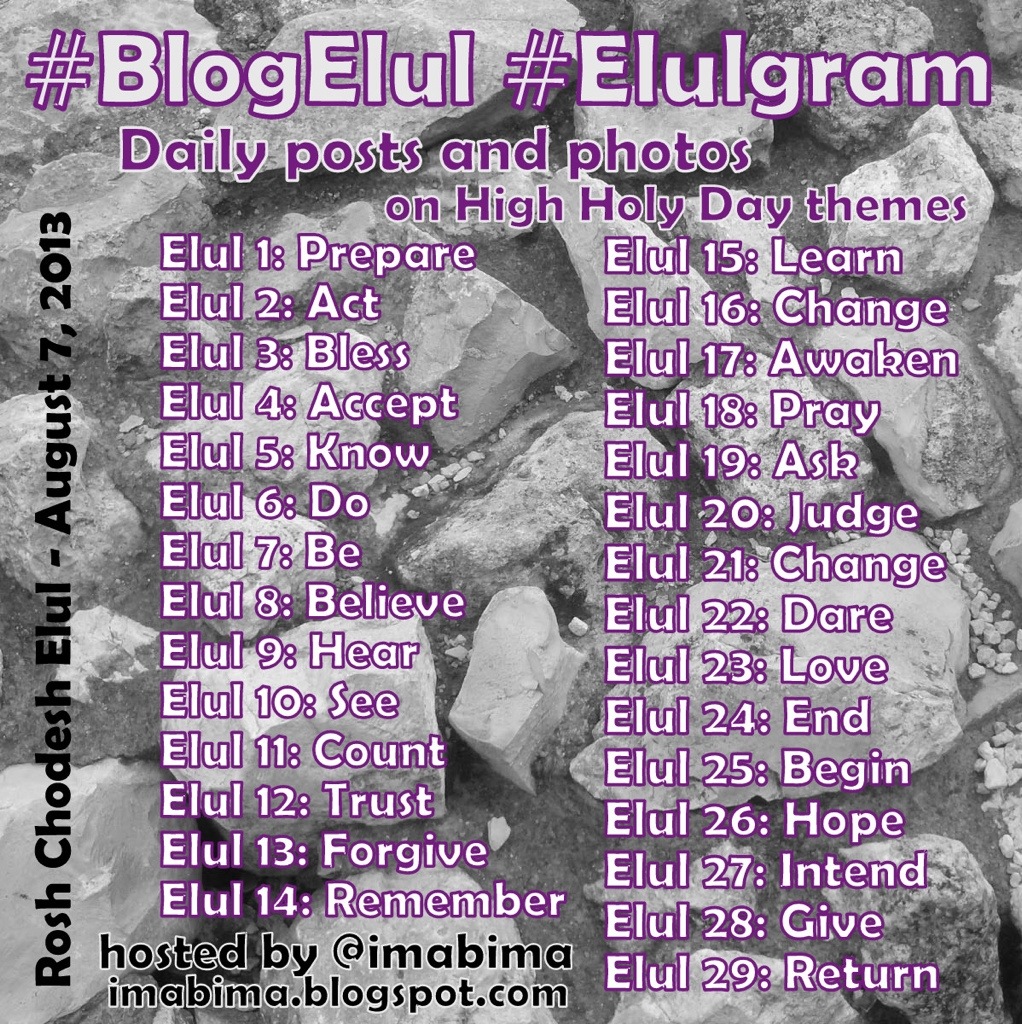
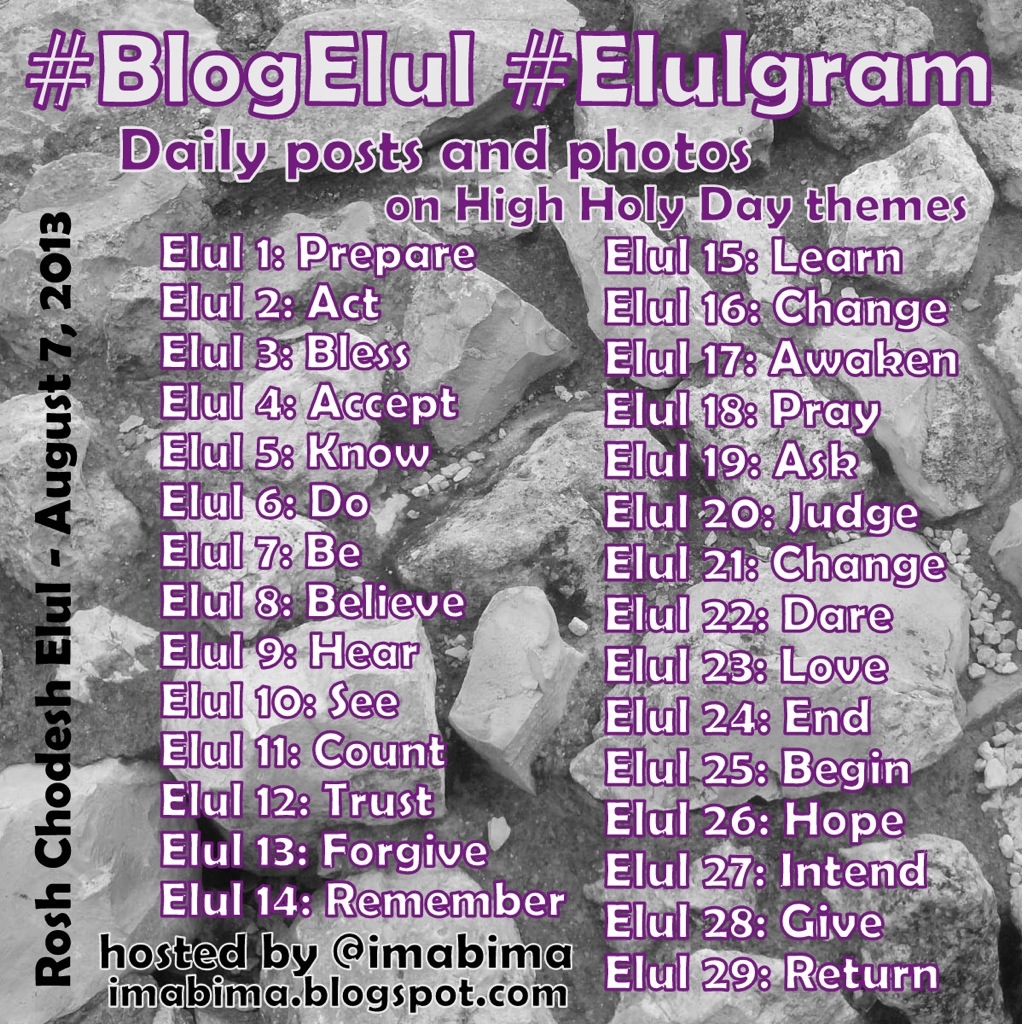
I’m participating in #blogelul this year. There are different writing prompts for every day as Jews around the world begin to prepare in body and spirit for the New Year, Rosh Hashanah. I don’t post on my blog on Shabbat so on Sunday I will select one of the themes from Saturday or Sunday for my posting. Here’s the Elul theme calendar.
The group will not meet on Rosh Hashanah, however there will be an incredible 25th anniversary celebration in Jerusalem for Rosh Chodesh Kislev. Here is the information about a special mission to Israel. If you are a rabbi here is the information about a special trip just for you.
Change can be really hard. However, in this case change is necessary. Women MUST be able to worship freely at the Western Wall. I pray that 5774 will be the year that religious pluralism will be returned to Jerusalem!
I’m participating in #blogelul this year. There are different writing prompts for every day as Jews around the world begin to prepare in body and spirit for the New Year, Rosh Hashanah. I don’t post on my blog on Shabbat so on Sunday I will select one of the themes from Saturday or Sunday for my posting. Here’s the Elul theme calendar.
Today I performed the mitzvah of comforting the bereaved. I attended the funeral for a colleague’s mother. While I was at the cemetery I went to visit my paternal grandparents grave. Grandma and Papa were amazing grandparents. MY SISTER, my cousins and I were extremely lucky to have them in our lives as long as we did.
As I’ve been talking to people at this season of the year, I’ve started to wonder what draws people to the synagogue on Rosh Hashanah and Yom Kippur when they are not there the rest of the year? I invite you to share your answer with me either via a comment on this blog post or via the new contact area of my webpage.
I find it meaningful to remember that I sit in synagogue just like my parents, grandparents, great-grandparents and so on did. They may or may not have believed in God. They may or may not have liked being there. Nevertheless they joined themselves to the chain of Jewish history and Jewish tradition.
Have you heard of Maslow’s hierarchy of needs? In short, a person achieves each of these needs in order to achieve self-actualization.
This is a version of that hierarchy for 2013 (and this is intended to be so funny it is true).
I’m participating in #blogelul this year. There are different writing prompts for every day as Jews around the world begin to prepare in body and spirit for the New Year, Rosh Hashanah. I don’t post on my blog on Shabbat so on Sunday I will select one of the themes from Saturday or Sunday for my posting. Here’s the Elul theme calendar.
Have you seen the Bar Mitzvah video? I confess I have not and I have no intention of watching it. (Note I am not even including a link). Odds are you might have. The video went viral and I’m sure with just a little google search you can see it.
What is of interest to me is the two responses to this video.
Rabbi David Wolpe wrote a response to this video in The Washington Post. You can read it here. I have never met Rabbi Wolpe though we live in the same city. I think he raises some important issues about the state of Bar/Bat Mitzvah in our world. I find that he isn’t really saying things that others haven’t said before him. Because he is who he is, he just gets a whole lot more press.
Rabbi Bill Gershon is this young person’s rabbi. Here is Rabbi Gershon’s response to Rabbi Wolpe.
August 16, 2013 at 4:16pm
A Response to Rabbi David Wolpe’s Article in the Washington Post
Dear David:
I hope this email finds you well. I felt I had to respond regarding your article that appeared in the Washington Post, “Have we forgotten what Bar Mitzvahs are all about?” You wrote: “…however beautiful his religious ceremony may have been, and however sincere the Judaism of his family (I don’t know and cannot judge)…” Well, that is true. You don’t know and you cannot judge. But I do know and I can judge.
I am Sam’s rabbi and have known him his entire life. And by the way, his name is Sam and not, as you mockingly call him, “Sammy.” Sam’s Bar Mitzvah was beautiful and meaningful, and Sam is not just some kid who had a blowout Bar Mitzvah party. He goes to our Hebrew School, has sung in the youth choir for years on Shabbat and the High Holidays, took his study of the Torah portion very seriously, loves being Jewish and loves Israel and the Jewish people. Sam requested that his guests not give him gifts, (the opposite of what most b’nai mitzvah do) but rather that they contribute money to the Ben Yakir Youth Village in Israel. To celebrate becoming Bar Mitzvah, Sam went to Israel with his family. Unlike many kids his age, (at the time he was not even 13), Sam was focused on helping under-privileged Israeli kids rather than doing the “touristy” activities that most B’nai Mitzvah trips stress. He took this mitzvah very seriously and raised $36,000.
You don’t know Sam, David, but I do and the Sam I know is a sweet kid with a sensitive neshama (soul). The Sam I know loves to lead services from the bimah and sing the songs of his people. The Sam I know may come from a family of great financial means, but whose largesse to the Jewish Community and to Israel is an inspiration to all of us who have the privilege of knowing them. And I can attest that not only has his family passed on the value of giving and Tzedakah to Sam, but they possess a deep sense of Jewish belonging and commitment which permeates their family and is very much in Sam’s heart and life.
The three minute dance he performed at his party, however questionable, hardly portrays a complete picture of who Sam is or his core values.
I have no problem with a rabbi railing against materialism, misplaced values, or exhorting the community to understand the sacred nature of Bar Mitzvah and its meaning. I have written and spoken about such issues for years in my own community. My issue with what you wrote, David, has to do with the vituperative tone of your words— the way they mock and humiliate one of the children of my synagogue in the public forum. Sam is not an object. He is a Tzelem Elohim, an image of God, who happens to have a passion for acting, dancing and singing.
I would have welcomed your criticism of the media’s misappropriation of “Bar Mitzvah” and the sensationalism that has followed. But your words play right into that sensationalism and buttress the real travesty of this matter – the egregious and hateful words many have directed at a child of God, which have now gone viral on the Internet and blogosphere.
This is the month of Elul, a month of self-reflection and repentance. Humiliating anyone in public, let alone a teenager, flies in the face of the values that we would both agree are at the very heart of what it means to become Bar Mitzvah and to be Jew.
No, David, you don’t know Sam Horowitz. And while I respect and love you, in this case I think you owe Sam an apology.
Best Wishes for a Shana Tovah.
Bill
Rabbi William Gershon,
Feldman Family Senior Rabbinic Chair
Congregation Shearith Israel
Dallas, Texas
As far as I can tell, Rabbi Gershon’s response has not been ‘picked up’ by any media. This was simply posted on Facebook on the congregation’s page. Rabbi Gershon aptly reminds all of us that it is always best to criticize an idea and not criticize a person.
Forgiveness is hard work. Asking for forgiveness is doubly hard. This is what Elul is all about.
I will update this blog post if I learn of any response from Rabbi Wolpe.
Do you text message? Unless you’re MY DAD, the answer to this question is probably yes. It turns out that text messaging is one of the most common ways people communicate. If you are communicating with a teenager, it is entirely possible that the most effective way for them to express themselves to you is not through speaking. It certainly isn’t through e-mail because that’s old technology. Text messaging is often the preferred means of communication.
Communication is one of the most important ways we build trust between people. How many times does something one person said and another person misunderstood or misheard destroy a sense of trust?
How we communicate as 21st century people is rapidly changing through the use of technology (says the rabbi/blogger writing from an iPad). Through social media we can communicate volumes through a picture in Instagram. And through the magic that is twitter (are you following me @rabbisteinman) we’ve managed to communicate volumes in 140 characters or less.
Emoji are now a part of our language, too. This article artfully explains the challenges of these emoji both here and abroad.
I am not a huge emoji user. Are you? What do you like about them? Do they enhance or hinder your communication?
Did you know that when you see something beautiful, an act of creation like a sunrise or sunset, a meteor shower or a beautiful plant there is a blessing to recite?
ברוך אתה ה׳ אלהינו מלך העולם שככה לו בעולמו.
Baruch atah, Adonai Eloheinu, Melech haolam, shekachah lo b’olamo.
Praise to you, Adonai our God, Sovereign of the universe, whose world is filled with beauty.
———-
Did you also know that the Central Conference of American Rabbis has an awesome blessings app? So when you’re out and about you can find the blessing you need when you need it. You can find out more about it here

 As you may know, #blogelul was the brainchild of my colleague, Rabbi Phyllis Sommer. Rabbi Phyllis and Rabbi Michael Sommer’s son SupermanSam is on day zero for a bone marrow transplant to treat the ninja cancer cells in his body. You can read all about SupermanSam on his blog.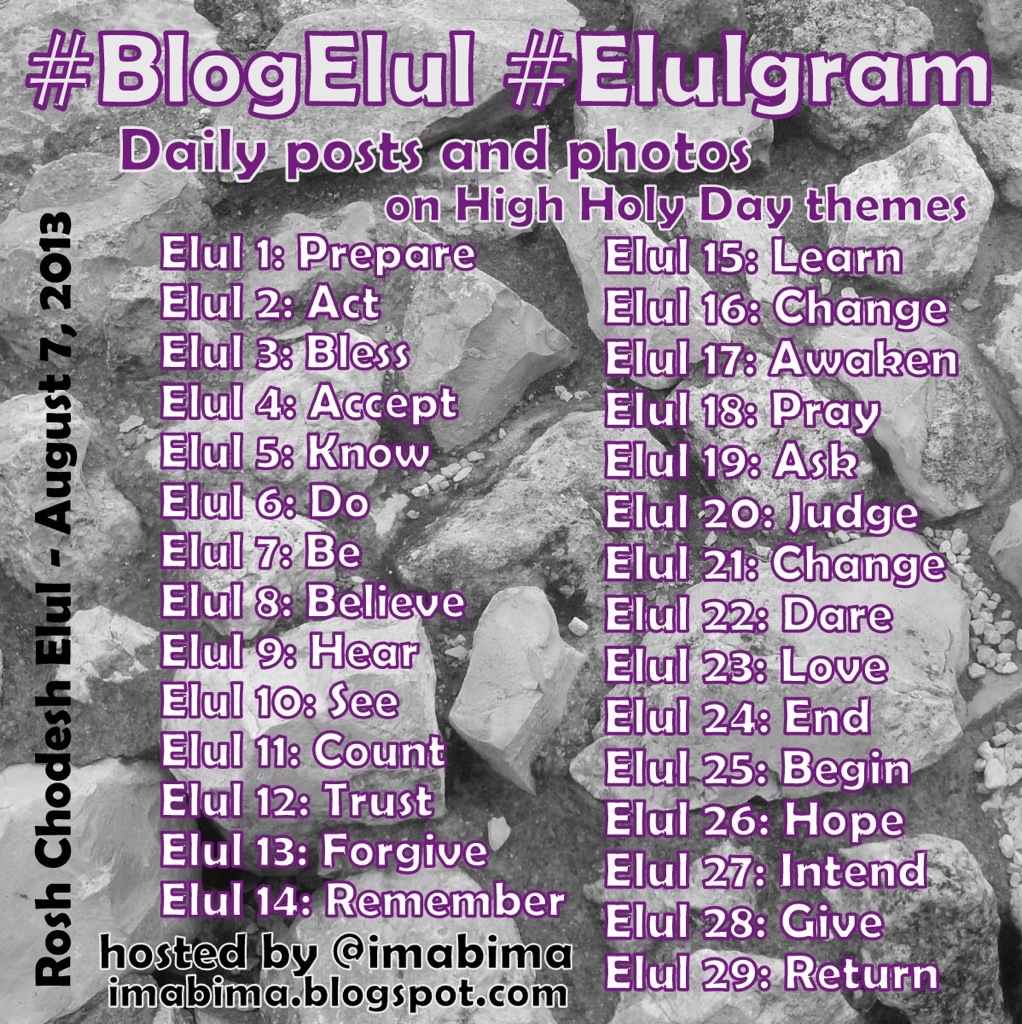





 Rabbi Eleanor Steinman